





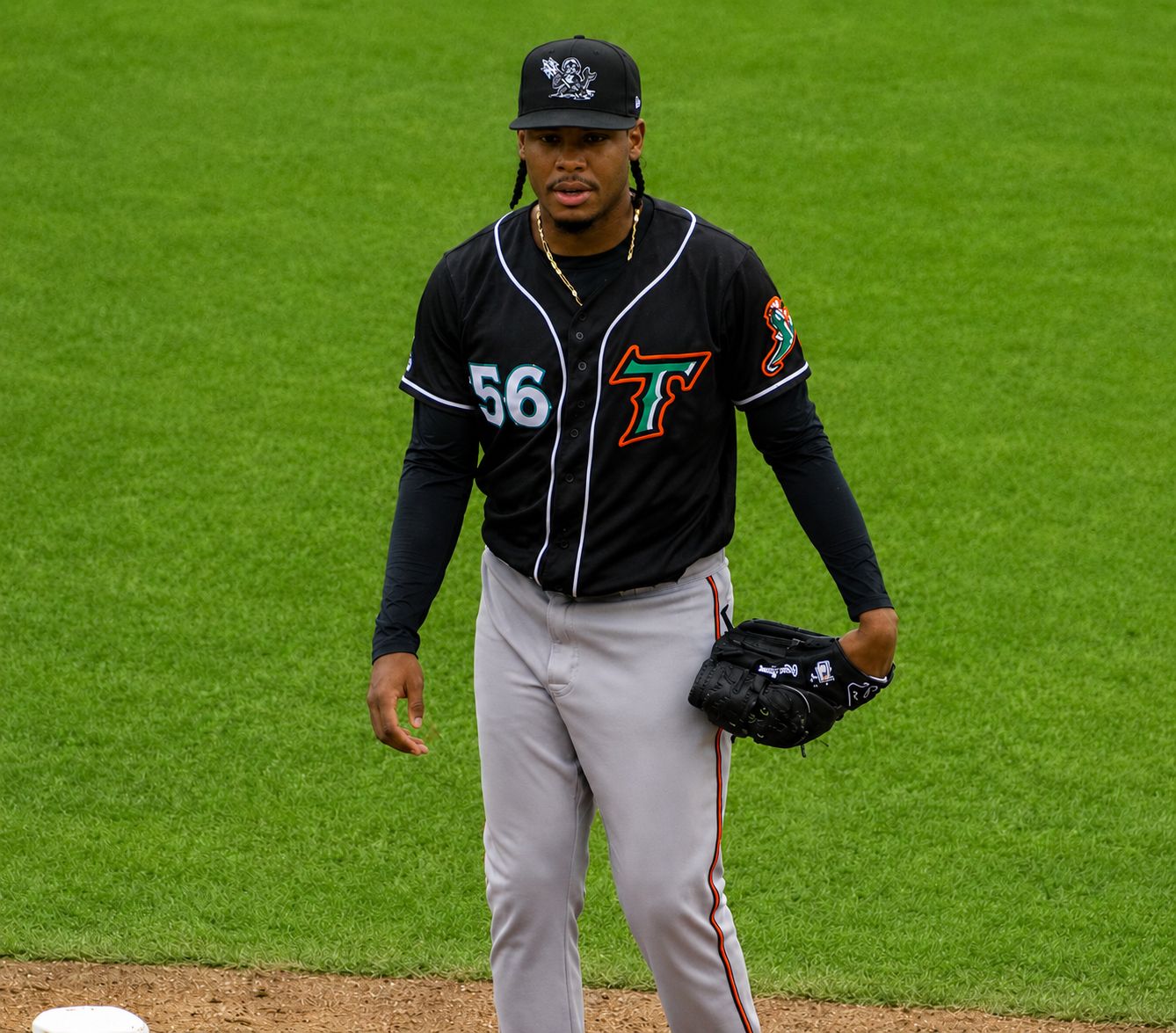
Yaqui Rivera’s 2026 season has put him on the radar. While it may appear that the Orioles are trying to make him a starter, they more likely are giving him controlled multi-inning mound time to sharpen the command of his arsenal.
That distinction matters.
Rivera has made some “starts” this season with Chesapeake and Norfolk, but the pitch counts tell the real story. Over his last seven outings, he has been between 43 and 52 pitches. That is not a starter workload. That is a developmental bullpen workload, enough pitches to let him use the full mix, but not enough to suggest the Orioles are trying to turn him into a five- or six-inning rotation arm.
With his effort delivery, east-west movement profile, and lack of big vertical separation on the breaking and off-speed pitches, the bullpen still looks like the best long-term fit.
The results that put him on the radar
| Split | AVG | OBP | SLG | OPS | BB% | K% |
|---|---|---|---|---|---|---|
| Total | .172 | .252 | .258 | .510 | 9.1% | 34.3% |
| vs. RHB | .164 | .243 | .239 | .482 | 9.5% | 39.2% |
| vs. LHB | .180 | .261 | .279 | .540 | 8.7% | 29.0% |
Between AA and AAA, the handedness splits are encouraging. Rivera is not just beating up on one side. Right-handed hitters have managed just a .164/.243/.239/.482 line against him, while left-handed hitters are at .180/.261/.279/.540.
The strikeout rate is the real separator. A 34.3% overall K rate will get anyone’s attention, and the fact that he is missing bats against both righties and lefties makes the profile more interesting.
Against right-handed hitters, the slider and breaking ball mix is clearly helping him generate swing-and-miss. Against left-handed hitters, the changeup gives him a legitimate weapon to keep them from sitting on the fastball. That is important if you are projecting him as more than a right-on-right bullpen arm.
Why the bullpen makes more sense
On paper, Rivera has enough pitches to look like a starter. In reality, the profile points more toward a multi-inning bullpen role.
| Pitch | Rivera profile | Why it matters |
|---|---|---|
| Sinker | 92-94 mph, heavy arm-side run | Early contact, sets up changeup |
| Changeup | 87-88 mph, arm-side fade | His best bat-missing off-speed weapon |
| Slider | Around 80 mph, big glove-side sweep | Key pitch, but must be located better |
| 4-seam | 94-95 mph with some ride | Needed to change eye levels |
| Curveball | Upper-70s, more lateral than vertical | Extra look, but may overlap with slider |
His delivery has effort. His arsenal is more horizontal than vertical. The sinker and changeup run arm-side. The slider and curveball move glove-side. The four-seam is the pitch that gives him the best chance to change eye levels.
That does not mean the stuff is bad. It just means the margin for error is thinner.
A starter with this kind of movement profile has to command extremely well because hitters get multiple looks at the same east-west lanes. In shorter bursts, though, the profile becomes much more interesting. Rivera can show five pitches, move hitters side-to-side, miss bats with the changeup, and use the four-seam enough to keep hitters from sitting on horizontal movement.
That feels like the role the Orioles are building toward.
The Jakob Junis path
The best MLB comp I could find is the Rangers’ Jakob Junis.
Junis has shown that a right-handed pitcher can carve out a useful major league career as a multi-inning reliever without a huge vertical breaking ball. The formula is command, sequencing, changing speeds, and moving hitters east-west.
| Pitch | Rivera | Jakob Junis 2026 | Similarity |
|---|---|---|---|
| 4-seam | 94.6 mph, 14.4 IVB, 7.7 arm-side | 91.9 mph, 12.9 IVB, 3.6 arm-side | Rivera has more velo |
| Sinker | 92.3 mph, 3.1 IVB, 15.8 arm-side | 91.6 mph, 6.5 IVB, 14.6 arm-side | Pretty close |
| Changeup | 87.5 mph, 1.4 IVB, 15.4 arm-side | 86.5 mph, 1.9 IVB, 13.1 arm-side | Very close |
| Slider | 80.0 mph, 4.5 IVB, 15.5 glove-side | 81.7 mph, 2.3 IVB, 16.3 glove-side | Very close |
Rivera actually has more fastball velocity than Junis, which gives him a little more upside. But Junis works because he commands the horizontal lanes. That is still the developmental gap Rivera has to close.
The location concern
After reviewing his pitch location charts, the biggest concern is the slider.
Rivera’s changeup locations look pretty encouraging. He is mostly getting that pitch down and arm-side, which is where it needs to live. That pitch gives him a real weapon against left-handed hitters and explains why the platoon split is not a major red flag.
The four-seam is important because it gives him a vertical lane. If he uses it enough up in the zone, hitters cannot simply sit on side-to-side movement. In his last appearance, Rivera went to a four-seamer heavy mix.
But the slider is leaking too much into the middle of the plate.
For a breaking ball without big vertical depth, that is a dangerous miss. A sweepy slider can work, but it has to finish off the plate or get to the edges. If it stays thigh-high and middle, major league hitters will punish it.
Could he help the Orioles this season?
Yes. Rivera could absolutely be a second-half bullpen option for the Orioles.
He is already in the upper minors. He is missing bats. He is getting both right-handed and left-handed hitters out. And the Orioles’ usage suggests they are preparing him for a multi-inning relief role, not a traditional starter role.
He would not have to come up as a high-leverage one-inning arm. His value would be as a bridge option: someone who can cover two innings, keep the game under control, and give the bullpen length.
Bottom line
Yacqui Rivera looks like a real bullpen candidate for the Orioles in mid/late 2026 and beyond.
The 43-to-52 pitch outings, effort delivery, east-west arsenal, and lack of big vertical movement all point toward a multi-inning relief role. The Orioles appear to be giving him extra mound time to refine the command, not trying to build him into a traditional starter.
The stuff is good enough. The changeup is real. The fastball velocity plays. The handedness splits show he can attack both sides.
But the slider is the separator.
If Rivera continues to miss in the middle with that pitch, major league hitters will expose him. If he learns to locate it better, either to the edge or off the plate as a chase pitch, then a Jakob Junis-type career becomes realistic.
That is the path: a multi-inning bullpen arm who can miss bats, change speeds, and give the Orioles useful innings.