





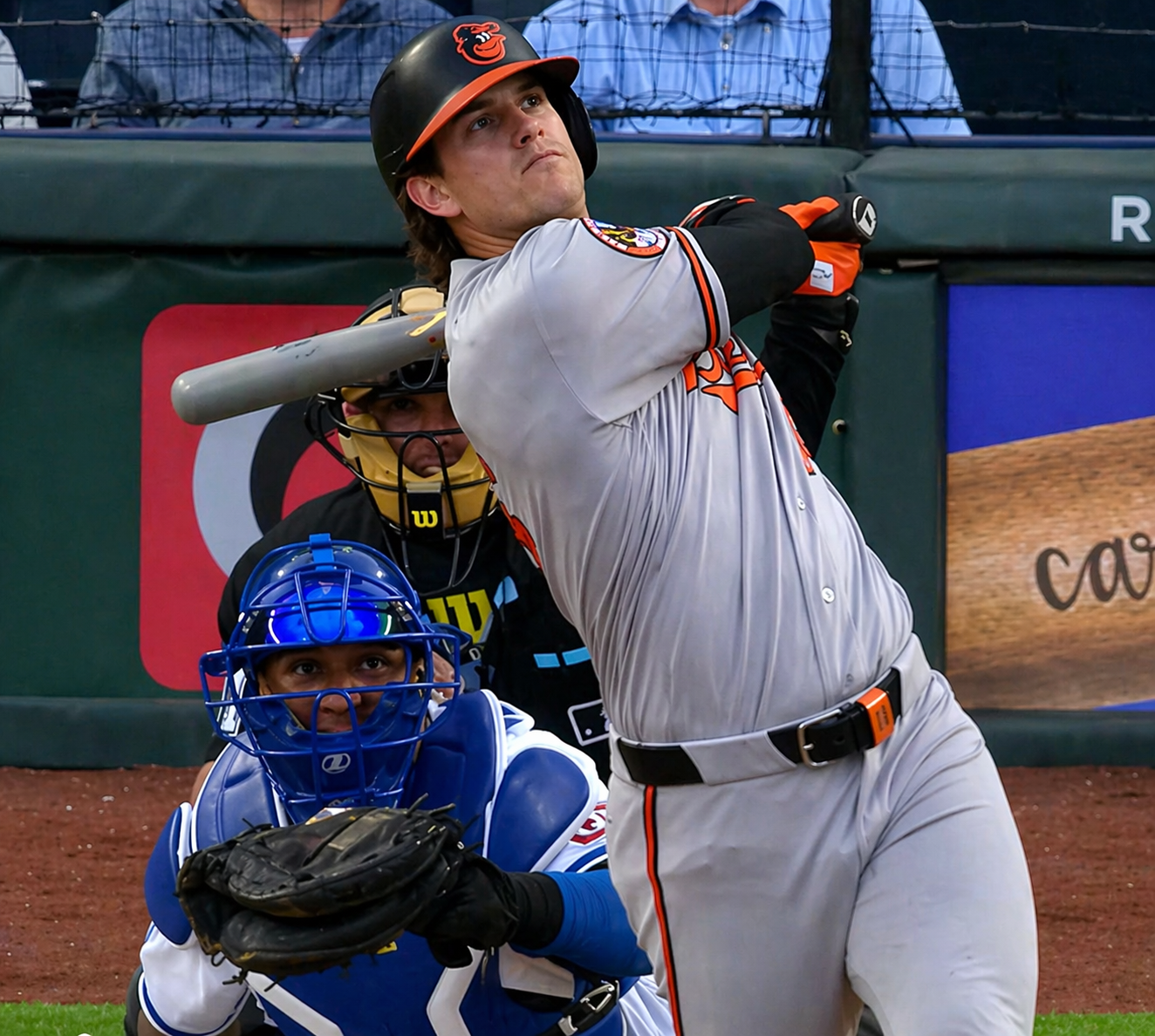
For most of this season, the Coby Mayo discussion has been pretty simple.
The power is obvious. The bat speed is obvious. The question has always been whether Mayo can make enough contact against major league pitching for that power to matter on a consistent basis.
More specifically, can he hit right-handed pitching well enough to become an everyday middle-of-the-order hitter?
For much of 2026, the answer has been no. Right-handers figured out pretty quickly that Mayo could be attacked with sliders and sweepers moving away from him, and there were stretches where he looked completely overmatched.
But there are two important parts to Mayo’s offensive profile right now.
First, he has already established himself as a legitimate left-handed pitching masher. That gives him a pretty solid major league floor even if the right-on-right breaking-ball issue never completely goes away.
Second, there are now some legitimate signs that the weakness against right-handed pitching may actually be improving.
That second part is what could determine whether Mayo becomes simply a useful major league power bat or the full-time middle-of-the-order hitter the Orioles have been hoping for.
Start With the Overall Numbers Against Right-Handed Pitching
Mayo’s season against right-handers has been uneven.
There have been stretches where he looked like he was getting close, followed by stretches where the contact completely fell apart.
The month-by-month whiff rate tells the story better than his batting average does.
| Month | Whiff Rate vs RHP |
|---|---|
| March/April | 32.4% |
| May | 22.8% |
| June | 43.0% |
| July | 41.0% |
| August | 28.4% |
| September 1-17 | 22.7% |
June and July were the real problem.
A 43 percent whiff rate in June and 41 percent in July is not something an everyday major league hitter can live with.
That wasn’t just bad luck either. In June, Mayo had a .117 xBA, .189 xSLG and .151 xwOBA against right-handed pitching.
He was getting beat.
But the last two months have looked different. His whiff rate dropped to 28.4 percent in August and is down to 22.7 percent so far in September.
That is the first thing that gets my attention.
The Expected Production Is Improving Too
It would be easier to dismiss the lower whiff rate if the quality of contact had gone backwards.
It hasn’t.
Mayo’s expected production against right-handed pitching has improved at the same time.
| Month | xwOBA vs RHP |
|---|---|
| March/April | .258 |
| May | .309 |
| June | .151 |
| July | .287 |
| August | .259 |
| September 1-17 | .457 |
That September number jumps off the page.
Through September 17, Mayo has a .457 xwOBA against right-handed pitching. He also has a .310 xBA and .723 xSLG.
His actual batting average is only .233, so if you are just looking at the traditional stat line, you are going to miss much of what is happening underneath it.
The quality of his contact has been much better than the results.
He’s Barreling the Ball Much More Often
The barrel numbers may be just as encouraging.
| Month | Barrels per PA vs RHP |
|---|---|
| March/April | 1.6% |
| May | 4.2% |
| June | 1.9% |
| July | 4.8% |
| August | 4.1% |
| September 1-17 | 12.1% |
Mayo is not simply making more contact.
He is starting to make more dangerous contact.
That’s exactly what you want to see from a hitter whose calling card has always been power.
And This Is Why Mayo Is Going to Have a Major League Role Regardless
Before getting into the breaking-ball problem, there is one part of Mayo’s profile that shouldn’t get lost.
He absolutely mashes left-handed pitching.
This isn’t a case where he simply has a normal platoon advantage. Mayo is doing serious damage against nearly every pitch left-handers throw him.
| Pitch vs LHP | BA | SLG | xSLG | EV | Whiff% |
|---|---|---|---|---|---|
| Four-Seam | .306 | .806 | .810 | 98.2 MPH | 11.6% |
| Changeup | .250 | .594 | .525 | 92.7 MPH | 45.8% |
| Sinker | .360 | .680 | .602 | 87.5 MPH | 23.2% |
| Curveball | .455 | 1.182 | .660 | 88.6 MPH | 23.3% |
| Slider | .412 | .941 | .794 | 92.1 MPH | 40.0% |
| Cutter | .333 | .667 | .686 | 102.3 MPH | 40.0% |
The four-seam numbers are probably the most impressive.
Mayo is hitting .306 and slugging .806 against left-handed four-seamers, with a .325 xBA and .810 xSLG.
His average exit velocity against them is 98.2 MPH, and he is only whiffing on 11.6 percent of his swings.
That’s not someone surviving against left-handed pitching.
That’s someone destroying it.
His improvement against left-handed sliders is just as interesting. Last year Mayo hit .111 and slugged .111 against them. This year he is hitting .412 and slugging .941 with a .794 expected slugging percentage.
His average exit velocity against those sliders jumped from 79.7 MPH to 92.1 MPH.
That gives Mayo a very real major league floor.
Even if he never completely solves right-handed breaking balls, there is value in a hitter who punishes left-handed pitching like this.
At worst, Mayo looks capable of being a power bat who starts against lefties, gets favorable matchups against certain right-handers and can give a team legitimate middle-of-the-order damage in those situations.
That’s a major league player.
The real question is whether he can become much more than that.
The Bat-Tracking Numbers Show Real Improvement
Mayo has also become a more explosive hitter overall.
His average bat speed increased from 74.7 MPH last year to 75.8 MPH this season.
His fast-swing rate jumped from 47.6 percent to 59.8 percent. His blast rate on contact increased from 14.1 percent to 16.8 percent.
The MLB average blast rate on contact is 14.0 percent.
| Bat Tracking Metric | 2025 | 2026 | MLB Average |
|---|---|---|---|
| Average Bat Speed | 74.7 MPH | 75.8 MPH | 71.7 MPH |
| Fast Swing% | 47.6% | 59.8% | 24.3% |
| Squared Up / Contact | 25.2% | 28.6% | 32.8% |
| Squared Up / Swing | 17.6% | 19.9% | 25.1% |
| Blast / Contact | 14.1% | 16.8% | 14.0% |
| Blast / Swing | 9.8% | 11.7% | 10.7% |
This is why I don’t think Mayo’s problem is a lack of major league impact.
The impact is already there.
The question has been whether he can get his barrel to enough pitches against right-handers to use it.
Right-Handed Breaking Balls Have Been the Real Problem
If you want to know why Mayo has struggled against right-handed pitching, start with sliders and sweepers.
For the season, Mayo has whiffed on 44 percent of his swings against right-handed sliders and 38.1 percent against right-handed sweepers.
Those are the pitches that have kept him from becoming the hitter the Orioles hoped he would be.
The scary part is how bad things got in the middle of the season.
When we combine sliders, sweepers and slurves from right-handed pitchers, Mayo’s month-by-month whiff rate looks like this:
| Month | Whiff% vs RHP Slider/Sweeper/Slurve |
|---|---|
| March/April | 30.0% |
| May | 25.8% |
| June | 57.9% |
| July | 55.6% |
| August | 48.4% |
| September 1-17 | 22.2% |
That middle stretch was brutal.
From June through August, Mayo was missing on roughly half his swings against those pitches.
There is no way around that. It’s a major league weakness, and pitchers were taking advantage of it.
But September has looked completely different.
So far this month, that whiff rate is down to 22.2 percent.
The Improvement Against Breaking Balls Goes Deeper Than Whiff Rate
The underlying numbers have changed too.
| RHP Slider/Sweeper/Slurve | June | August | Sept. 1-17 |
|---|---|---|---|
| Whiff% | 57.9% | 48.4% | 22.2% |
| xBA | .151 | .058 | .366 |
| xSLG | .289 | .069 | .906 |
| xwOBA | .186 | .053 | .526 |
| Exit Velocity | 93.5 MPH | 87.7 MPH | 93.4 MPH |
| Bat Speed | 75.9 MPH | 74.5 MPH | 77.1 MPH |
| Barrel / PA | 5.6% | 0.0% | 16.7% |
| Average Miss Distance | 9.8 inches | 6.0 inches | 4.5 inches |
That’s a pretty dramatic change.
The whiff rate is down. The expected production is way up. The bat speed is up. The barrel rate is up.
And his average miss distance has gone from 9.8 inches in June to 4.5 inches in September.
That last number may be the one worth watching most closely.
He is simply getting closer to the baseball.
The Obvious Warning Is the Sample Size
This September breaking-ball sample consists of only 18 pitches and six at-bats.
That is nowhere near enough to say Mayo has solved the problem.
I wouldn’t make that claim.
But I also wouldn’t ignore what is happening.
The improvement is occurring in the exact area that has been holding him back.
That’s what makes it interesting.
Has Mayo Made a Mechanical Adjustment?
There have also been some noticeable changes to Mayo’s swing and setup.
Statcast measured his stance at just five degrees open last season. This year it is 21 degrees open.
His swing-path tilt increased from 36 degrees to 39 degrees, while his attack angle went from 11 degrees to 15 degrees.
| Swing Metric | 2025 | 2026 | MLB Average |
|---|---|---|---|
| Stance | 5° Open | 21° Open | 11° Open |
| Swing Path Tilt | 36° | 39° | 32° |
| Attack Angle | 11° | 15° | 10° |
| Ideal Attack Angle% | 45.1% | 48.8% | 50.9% |
That may help explain both sides of the Mayo story.
The more open stance may be helping him see the ball better, get his hips moving and get to velocity.
It may also be part of why he has become such a dangerous hitter against left-handed pitching.
But it could also make it harder to stay on a breaking ball moving away from him if he opens too early against a right-hander.
That’s why the recent reduction in miss distance is so interesting.
Maybe he is starting to find a better balance.
What Does Mayo Really Need to Fix?
I wouldn’t overhaul his swing.
There is too much good happening.
He has real bat speed. He is producing more blasts. He is hitting the ball hard. And he is already a major threat against left-handed pitching.
The adjustment against right-handers may be much simpler.
He needs to let breaking balls travel a little deeper, stay through the outer half longer and avoid trying to pull every pitch.
The other part is pitch recognition.
Sometimes the answer to a slider six inches off the plate isn’t figuring out how to hit it.
It’s not swinging at it.
If Mayo can force right-handed pitchers to bring those breaking balls back into the strike zone, his power gives him a chance to do plenty of damage.
So What Kind of Hitter Can Mayo Become?
I think this is where the evaluation gets pretty straightforward.
Even if Mayo never completely solves right-handed breaking balls, I think he has enough offensive value against left-handed pitching to have a meaningful major league career.
A player who can punish lefties the way Mayo does has a role.
The question is whether that role becomes much bigger.
If he continues whiffing 40 to 50 percent of the time against right-handed sliders and sweepers, he probably settles into more of a matchup-driven power bat.
That still has value.
But if the recent improvement is real and Mayo can bring that whiff rate down into the 25 to 30 percent range while maintaining this kind of bat speed and impact, the ceiling changes dramatically.
Then you are talking about a hitter with legitimate 30-plus home run potential who can stay in the lineup every day.
That’s a middle-of-the-order hitter.
That’s Why September Matters
The important part of Mayo’s recent improvement isn’t simply that his results are better.
It’s where the improvement is happening.
Major league pitchers identified his weakness. They attacked it repeatedly. For much of the summer, Mayo did not have an answer.
Now, at least for a couple of weeks, the underlying numbers suggest he may be starting to find one.
The whiff rate is down. The miss distance is down. The expected production is way up. The bat speed is still there.
We are nowhere near having enough data to declare the problem solved on September 17.
But Mayo has already shown enough against left-handed pitching to establish that he belongs in the major leagues in some capacity.
What happens against right-handed breaking balls will determine whether he becomes something much more.
If this September adjustment is real, the Orioles may still have the everyday middle-of-the-order power hitter they thought they were developing.