






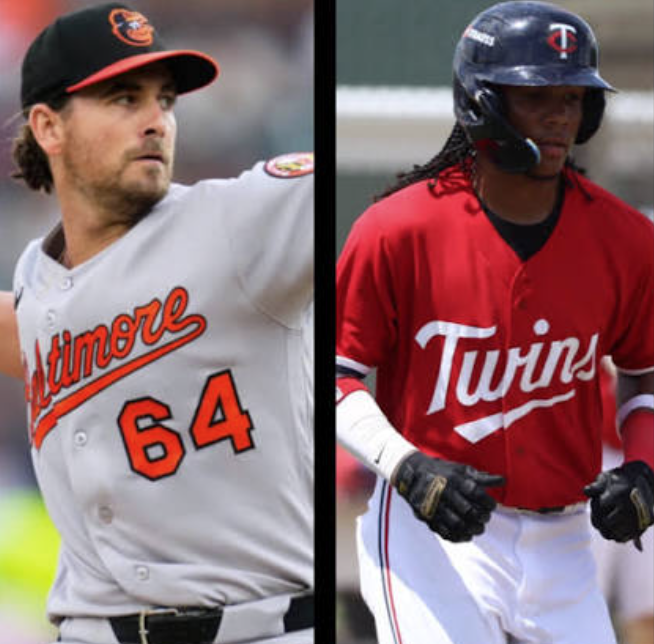
Before yesterday, I had never heard of Jhomnardo Reyes so take this scouting report as based off available information and scouting reports rather than a first-hand look. I’ll have more once I get eyes on after he arrives in Delmarva. Acquired for starting pitcher Dean Kremer, Reyes is a high ceiling, young outfielder who has already put up good numbers in the rookie leagues.
Jhomnardo Reyes is a high-upside, power-oriented left-handed outfielder whose underlying contact quality is more impressive than his traditional stat line alone suggests. At only 18, he has already produced a 120 wRC+ in the Dominican Summer League and followed it with a 138 wRC+ in the Florida Complex League while substantially reducing his strikeout rate.
The most encouraging part of the profile is that his production is supported by legitimate impact data:
- 92.4 mph average exit velocity
- 107.2 mph 90th-percentile exit velocity
- 110 mph maximum exit velocity
- 49.1% hard-hit rate
- .245 ISO
- .483 wOBA on contact
Those are unusually strong contact-quality indicators for a hitter his age. Reyes is not simply beating up inexperienced defenders or benefiting from a high BABIP. He is already impacting the baseball at a level that gives him a realistic chance to develop into a middle-of-the-order corner outfielder.
The main question is whether his plate discipline will remain functional against pitchers with better command and secondary stuff. His walk and strikeout rates look strong, but the pitch-decision data are much less convincing.
Offensive production
Across both levels in 2026, Reyes has hit:
.272/.396/.489 with 12 doubles, three triples, seven home runs and a 125 wRC+ in 220 plate appearances.
His Complex League performance was even better:
.296/.409/.541, 14% walk rate, 22.3% strikeout rate and a 138 wRC+ in 193 plate appearances.
The improvement from his 2025 DSL season is meaningful. Reyes lowered his strikeout rate from 28.5% to 22.3% while increasing his ISO from .177 to .245. Usually, a young hitter who begins selling out for more power also produces more swing-and-miss. Reyes instead added power while making more contact.
That combination is what gives him significant offensive upside.
His first seven full-season games have produced only two hits in 27 plate appearances, but that sample should not be treated as evidence that he cannot handle the level. Reyes has six walks and six strikeouts during that stretch, along with a .133 BABIP. The results have been poor, but the underlying plate-appearance outcomes have not collapsed.
Power
Power is clearly Reyes’ carrying tool.
His 107.2 mph 90th-percentile exit velocity ranks in the 95th percentile, while his maximum exit velocity ranks in the 91st percentile. More importantly, the power is not limited to a handful of isolated swings. His 92.4 mph average exit velocity and 49.1% hard-hit rate demonstrate consistent impact.
Reyes is already creating favorable power contact:
- 26.4% pull-air rate
- 39.6% ground-ball rate
- Approximately 50% pull rate in the Complex League
- 38.7% fly-ball rate
- 7% barrel rate
His swing and batted-ball direction are designed to produce damage to the pull side. He is not a slap hitter who may eventually grow into power. The swing is already built around lifting pitches he can drive.
There is still some launch inconsistency. His 25.6% infield-fly rate in the Complex League was high, and it followed a 29.8% mark in the DSL. Reyes can get underneath the ball and generate harmless popups when his timing or contact point is off. Refining his launch-angle distribution could allow him to turn more of his hard contact into extra-base hits.
The public 55 power grade is justified, and there is a plausible future 60-grade raw-power outcome as his 6-foot-3 frame continues to mature. A projection of 20-plus home runs is reasonable, with more available if his approach and launch consistency develop.
Hit tool and contact ability
Reyes’ contact profile is better than might be expected from a young power hitter.
His overall marks include:
- 22.3% strikeout rate
- 27.4% whiff rate
- 81.6% zone-contact rate
- 12.2% swinging-strike rate
- 72.2% contact rate in the Complex League
Those are not elite contact numbers, but they are playable alongside his power. He is not currently showing the extreme swing-and-miss that often accompanies this type of physical and batted-ball profile.
His performance against left-handed pitching is also encouraging, although the sample is small. Reyes hit .281/.465/.531 in 43 plate appearances against left-handers. There is no early statistical indication that he needs to be shielded from same-side pitching.
A future 45 hit tool remains the most appropriate projection. There is a path to a 50 if the pitch decisions improve, but his current approach creates more risk than his strikeout rate alone suggests.
Plate discipline: the conflicting indicator
This is the most complicated part of Reyes’ evaluation.
On the surface, a 14% walk rate against a 22.3% strikeout rate is excellent for an 18-year-old. However, the tracking data show:
- 38.5% chase rate — ninth percentile
- 61.3% zone-swing rate
- 43.3% overall swing rate
- 40.5% first-pitch strike rate across the minor-league sample
Reyes is taking plenty of pitches, but he is not necessarily identifying balls and strikes at an advanced level. He is relatively passive overall and does not attack an especially high percentage of pitches in the strike zone, yet he still expands frequently when he does swing.
That can create a deceptive statistical profile. Complex League pitchers often struggle to throw strikes, allowing a hitter to draw walks even without consistently strong pitch recognition. Reyes has frequently been placed in favorable counts because opposing pitchers have missed the zone, rather than because he has controlled every plate appearance.
Better pitchers may challenge him differently. They will get ahead more frequently, land breaking balls for strikes and then expand the zone. Reyes must improve at distinguishing hittable strikes from chase pitches, particularly spin moving away from him.
The ideal adjustment is not simply to swing less. He already has a moderate overall swing rate. He needs to become more aggressive against pitches in his damage zones and less aggressive against pitches outside them.
His future offensive outcome may depend more on that development than on adding additional strength.
Baserunning and speed
Reyes has 17 stolen bases, but the raw total overstates his current baserunning value. He has also been caught 13 times, giving him a success rate of only 56.7%.
He possesses approximately average straight-line speed and enough athleticism to play the outfield, but his reads, timing and decision-making on the bases need considerable work. At this stage, stolen-base attempts are developmental rather than a true offensive weapon.
As Reyes adds strength, his speed could settle closer to slightly below average. He may continue stealing an occasional base, but he does not presently project as a meaningful baserunning contributor.
Defensive projection
Reyes has played all three outfield positions, but right field remains the most logical long-term destination.
At 6-foot-3 and 186 pounds, he still has room to add physicality. His current average speed gives him some center-field flexibility, but his anticipated physical growth and offensive profile point toward a corner. An average arm should be sufficient for right field, provided his routes and reads continue improving.
The likely defensive outcome is adequate rather than impactful. Because he probably will not create significant value with his glove or legs, the bat will need to carry the profile.
That increases the importance of his offensive approach. A center fielder could survive with a volatile hit tool; a corner outfielder must consistently reach base and produce power.
Performance context
Reyes’ overall line was helped considerably by an enormous May:
- May: .378/.511/.892, four home runs, 1.403 OPS
- June: .236/.356/.347, .704 OPS
- July: .254/.372/.423, .795 OPS
The decline after May does not erase the underlying offensive ability, but it explains the “high context sensitivity” designation. He was not continuously dominating at the same level throughout the season.
His last 28 days produced a more modest .224/.370/.362 line, although he continued to walk and remained productive enough to reach base. The month-to-month results suggest that Reyes is still learning to adjust after pitchers alter their plans against him.
That is normal for an 18-year-old. The positive is that he has continued controlling his strikeout rate even when the hits and power have slowed.
Projection
Reyes has the ceiling of an everyday power-hitting right fielder, potentially batting in the middle third of a major-league lineup. His combination of age, physical projection and premium exit velocities gives him one of the more interesting offensive ceilings among lower-level prospects.
The median outcome is more likely a power-oriented corner outfielder whose batting average and on-base percentage fluctuate depending on his pitch recognition. If the chase problems become more pronounced against advanced pitching, he could settle into a platoon or bench role despite his raw power.
Projected grades
| Tool | Grade | Evaluation |
| Hit | 45 | Playable contact ability, but approach creates risk |
| Raw power | 60 | Premium exit velocities with additional physical projection |
| Game power | 55 | Already accessing pull-side power; launch consistency can improve |
| Run | 50/45 | Average present speed that may decline with maturity |
| Arm | 50 | Sufficient for right field |
| Field | 50 | Corner-outfield projection with some current versatility |
| Overall | 40+ | High-risk lower-level prospect with legitimate 45-FV+ upside |
Bottom line
Reyes should be viewed as more than a statistical Complex League performer. His exit velocities, hard-hit rate, power production and improved strikeout rate provide tangible evidence of a potentially impactful major-league bat.
The profile is not yet complete. His strong walk rate masks questionable swing decisions, his baserunning has been actively harmful, and his likely corner-outfield destination puts considerable pressure on his offense. Still, an 18-year-old generating this level of contact quality while keeping his strikeout rate near 22% is a very promising foundation.
He is a power-first prospect with everyday upside, but his advancement will be determined by whether he develops genuine strike-zone judgment rather than continuing to rely on lower-level pitchers missing the zone.