





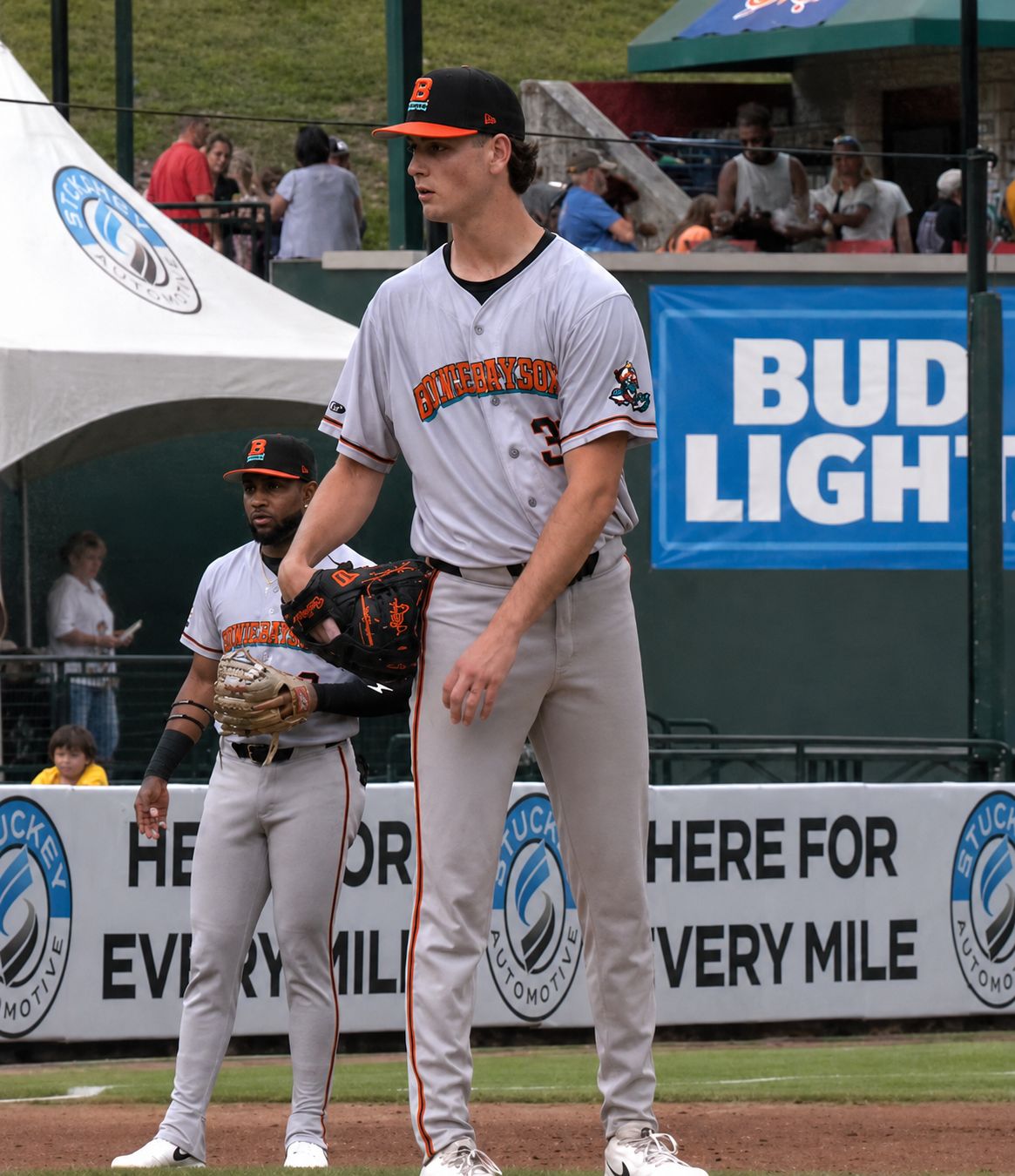
As of June 16, Joseph Dzierwa remains one of the more interesting starting pitching prospects in the Orioles system, but the last two outings add some needed nuance to the profile.
The overall resume is still very strong. The 22-year-old left-hander is 6-foot-8, 200 pounds, and has taken a real step forward in 2026. He has struck out 79 hitters in 62.1 innings, owns a 2.31 ERA, and has issued multiple walks in a start just twice all season. His overall minor league line backs up the eye test: a 30.5% strikeout rate, 5.5% walk rate, 25.0% K-BB rate, 16.2% swinging-strike rate, 31.8% CSW rate, .183 opponent average, 0.91 WHIP, 2.47 FIP, and 3.75 xFIP.
That is a very strong combination of bat-missing, strike-throwing, and run prevention.
The appeal is not hard to see. Dzierwa is a massive left-hander with a lower three-quarter slot, some deception, and a fastball that has been better than advertised this year. Fangraphs noted that his velocity has jumped from more of a 90-93 mph range in college to more 93-95 early in 2026, and also noted that hitters do not appear to pick the ball up well out of his hand. That matches what I have seen at times though he does sit more 92-93 in his last two outings. When the fastball is 93-95 and touching 96, it plays up because of the angle, release, and deception. Hitters either get frozen by it or swing under it.
The June 9 outing showed the upside of the fastball. He struck out six, and all six came on the heater. He touched 96, got swings through 94-96, and showed that the pitch can be more than just a setup offering for the changeup. That matters. If Dzierwa’s fastball is going to miss bats on its own, the ceiling moves beyond the typical polished college lefty profile.
But the last two outings also showed why he is not a finished product.
The velocity has been inconsistent. On June 9, he was still mostly 92-95 and touched 96, but there were stretches where he dipped into the low 90s. On June 14, after the weather delay and the unusual usage where he warmed up, sat, and then had to re-warm after Ben Vespi opened, it was the lowest velocity I have seen from him. He sat more 90-93, and never looked especially comfortable. That may have been tied to the disrupted routine, but it is still worth noting.
He also looks like a slow starter at times. The first inning of work on June 14 was rough. He faced eight batters, needed 23 pitches, hit a batter, gave up multiple singles, and just did not look warm or synced up. His changeup command was off, the breaking ball did not consistently finish, and the fastball did not have the same crispness. To his credit, he settled in and competed, but that early-inning rhythm is something to monitor.
The secondary mix is also becoming more layered. The changeup is still the best secondary and the pitch that gives him starter value. When he commands it down and away, it gets whiffs, soft contact, and awkward swings. But on June 14, the changeup command was not sharp. He missed low, yanked some away, and did not have the same consistent feel. That matters because the changeup is his separator.
The slider/sweeper/curveball usage is also interesting. Earlier in the season, the slider looked like the third pitch that needed to keep improving. In the last two outings, he showed more of a mid-to-upper-70s sweeper/curveball look in addition to the low-80s slider. Some of those sweepers had decent shape and got whiffs, but overall it was inconsistent. There were some noncompetitive misses, some soft sweepers, and a few that were hit hard. It gives him another look, but right now it feels more like a developing wrinkle than a consistently reliable weapon. If he can mix in this mid-70s version of his sweeper/curveball to go along with the harder slider, this gives him another weapon to use to keep batters uncomfortable.
That said, the batted-ball profile remains encouraging. Dzierwa’s infield-fly rate is high, and that is a good thing. He is not just giving up dangerous fly balls. A lot of hitters are getting underneath the fastball or making uncomfortable contact. His overall 32.2% IFFB rate supports what the eye test suggests: hitters are not consistently squaring him up. His Double-A xFIP of 3.53 and overall xFIP of 3.75 are also encouraging because they account for likely home run regression and still view him as a quality arm.
So the updated assessment is this:
Dzierwa is not just a back-end command lefty. He is a deceptive 6-foot-8 left-hander with a fastball that can miss bats, a real changeup, strong strike-throwing ability, and enough breaking-ball variation to keep hitters from sitting on one shape. The fastball/changeup combination is the foundation, and the deception makes both pitches play up.
The caution is that the velocity and rhythm have not been completely consistent. He can look out of sync early, especially when his delivery timing is off, and the breaking ball quality still comes and goes. The June 14 outing in particular showed what happens when he does not have his best fastball life or changeup command. He can still survive because of deception, strike-throwing, and competitiveness, but the ceiling depends on the mid-90s fastball showing up consistently and one of the breaking balls becoming a dependable third pitch.
As of June 16, Dzierwa is looking like a legitimate major league pitching prospect with mid-rotation upside. A 6-foot-8 lefty throwing low-mid-90s from a low three-quarter slot, missing bats, limiting walks, generating infield flies, and succeeding in Double-A is not a generic back-end profile.
He is a legitimate Orioles starting pitching prospect, and one whose stock is moving up.