





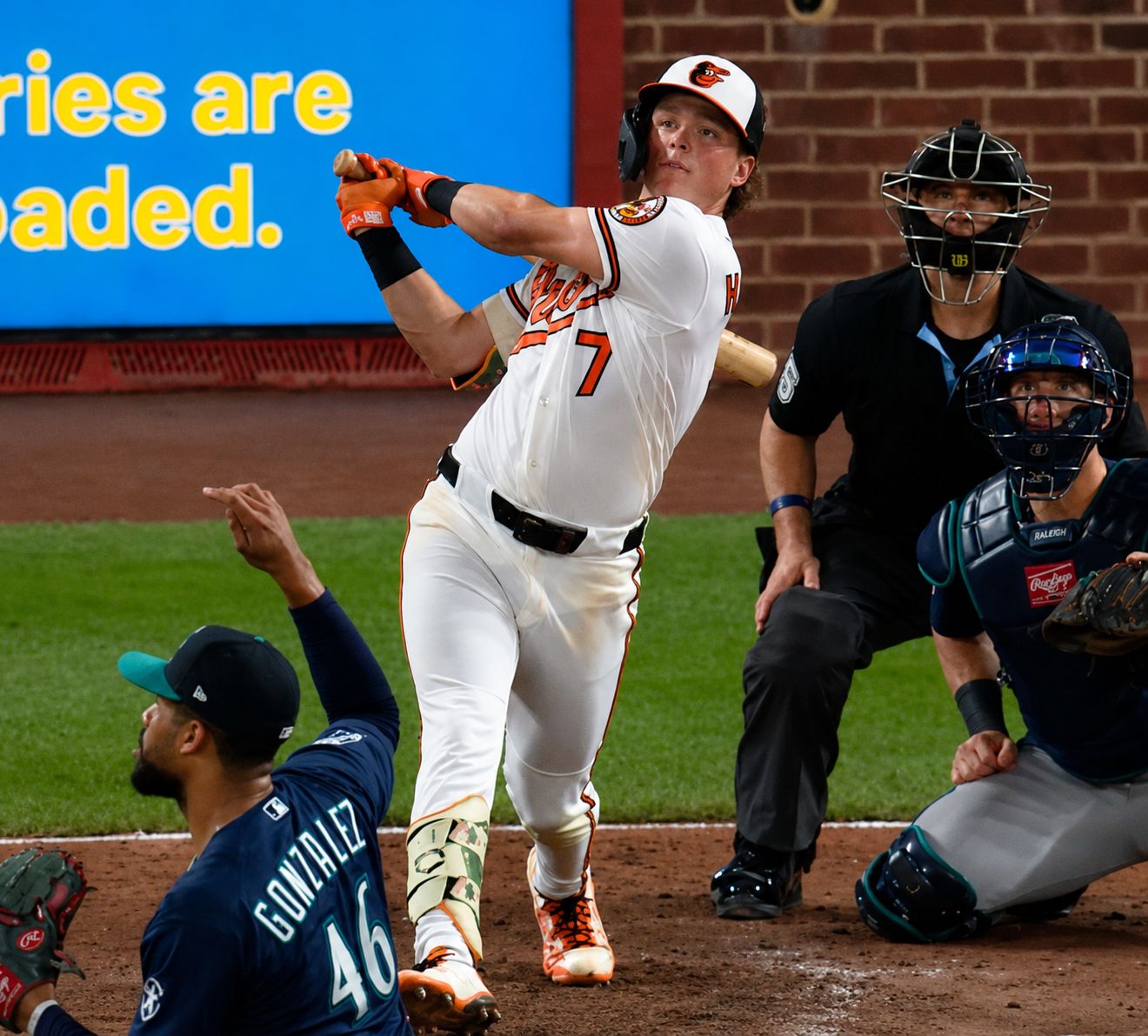
Jackson Holliday’s stats this season so far do not scream breakout, but the underlying data is much more encouraging.
The batting average is down, and the strikeouts are back up. That part is real. But Holliday is also hitting the ball harder, lifting it more, barreling it more often, and walking more. That is not the profile of a player who is overmatched or needs more development anywhere but at the major league level.
It looks more like a young hitter who has improved his damage profile, but now has to regain the contact gains he showed in 2025.
The biggest reason for optimism
The impact indicators have taken a real step forward in 2026.
| Metric | 2024 | 2025 | 2026 | 2025 to 2026 Change | Takeaway |
|---|---|---|---|---|---|
| Barrel % | 8.2% | 7.8% | 14.3% | +6.5 | Much more impact contact |
| Barrel/PA | 4.8% | 5.4% | 8.5% | +3.1 | More game power per plate appearance |
| Hard-Hit % | 45.1% | 40.8% | 44.9% | +4.1 | Back near his 2024 level |
| Avg. Launch Angle | 8.6 | 8.9 | 15.5 | +6.6 | Much better lift |
| LA Sweet-Spot % | 27.0% | 32.4% | 44.9% | +12.5 | More balls hit at productive angles |
| xSLG | .337 | .404 | .432 | +.028 | Expected power is improving |
| xwOBA | .263 | .314 | .329 | +.015 | Overall expected production is up |
| BB% | 7.2% | 8.6% | 11.0% | +2.4 | Better on-base foundation |
This is the core of the impact argument. Holliday is not just showing empty patience or weak contact. He is producing more barrels, more lift, more hard contact, and better expected power.
The batted-ball shape has changed
The most important change is that Holliday is no longer beating half of his balls into the ground.
| Metric | 2024 | 2025 | 2026 | Change Since 2025 | What it means |
|---|---|---|---|---|---|
| Ground Ball % | 56.6% | 49.0% | 32.7% | -16.3 | Fewer balls beaten into the ground |
| Air % | 43.4% | 51.0% | 67.3% | +16.3 | More balls with extra-base potential |
| Fly Ball % | 27.0% | 25.1% | 34.7% | +9.6 | More lift |
| Line Drive % | 13.9% | 21.9% | 26.5% | +4.6 | More quality contact |
| Pull Air % | 11.5% | 10.7% | 18.4% | +7.7 | More damage to the pull-side air |
This is a real development. Holliday’s swing is producing a better damage shape. He is getting the ball in the air more often, and he is doing it with better contact quality.
The problem is still swing-and-miss
The reason Holliday has not fully broken out is obvious. The swing-and-miss has returned.
| Metric | 2024 | 2025 | 2026 | 2025 to 2026 Change | Concern |
|---|---|---|---|---|---|
| K% | 33.2% | 21.6% | 29.3% | +7.7 | Too many strikeouts |
| Whiff % | 34.1% | 24.5% | 32.6% | +8.1 | Overall contact has regressed |
| Zone Contact % | 75.7% | 81.6% | 75.0% | -6.6 | Missing more hittable pitches |
| Chase % | 27.2% | 22.3% | 23.8% | +1.5 | Still manageable |
| Chase Contact % | 43.0% | 53.6% | 47.5% | -6.1 | Less contact when he does expand |
The good news is that his chase rate is not the major issue. He is not expanding the zone at an alarming level. The bigger issue is that he is missing too many pitches when he does swing, including pitches in the zone.
Pitchers have a clear attack plan
Holliday’s 2026 pitch-type data shows the current problem clearly.
| Pitch Type | xBA | xSLG | xwOBA | Whiff % | Read |
|---|---|---|---|---|---|
| Fastballs | .245 | .514 | .374 | 25.6% | He can damage velocity |
| Breaking Balls | .129 | .152 | .178 | 50.0% | This is the clear hole |
| Offspeed | .279 | .578 | .396 | 32.0% | Still dangerous when he connects |
This is the next adjustment. Holliday is doing enough damage against fastballs and offspeed to keep the upside alive. But breaking balls are still a problem, and pitchers know it.
Holliday compared to Gleyber Torres and Brandon Lowe
Gleyber Torres and Brandon Lowe are better offensive reference points for Holliday than Ketel Marte.
Torres is the better age-based comp. His 2019 season came at age 22, the same age Holliday is now. Lowe is the better profile-based comp because his impact has come through lift, barrels, walks and power, even with swing-and-miss in the profile.
| Player | Season | Age | EV | Barrel% | Hard-Hit% | Avg LA | Sweet-Spot% | xSLG | wOBA | xwOBA | K% | BB% |
|---|---|---|---|---|---|---|---|---|---|---|---|---|
| Jackson Holliday | 2026 | 22 | 89.1 | 14.3% | 44.9% | 15.5 | 44.9% | .432 | .285 | .329 | 29.3% | 11.0% |
| Gleyber Torres | 2019 | 22 | 89.1 | 11.0% | 36.8% | 17.6 | 38.2% | .492 | .358 | .340 | 21.4% | 7.9% |
| Brandon Lowe | 2019 | 24 | 91.6 | 17.5% | 46.2% | 19.2 | 40.2% | .497 | .354 | .339 | 34.6% | 7.6% |
Bolded numbers highlight where the player is strongest among the comp group.
This chart does a better job of framing Holliday’s upside.
The Torres comparison is useful because Torres was not an elite exit velocity hitter at age 22. His average exit velocity was the exact same as Holliday’s current 89.1 MPH. The difference is that Torres made more contact, struck out less and converted his contact quality into much better production. That is the path Holliday needs to chase if he is going to become a more complete impact bat.
The Lowe comparison is useful for a different reason. Lowe shows that a second baseman can still be an impact offensive player with strikeouts in the profile, as long as the barrel rate, lift and power output are strong enough. Holliday’s current barrel rate is not far off Lowe’s 2019 level, and his walk rate is actually better.
The key separator is contact.
Torres showed the lower-strikeout version of the impact second baseman path. Lowe showed the higher-strikeout, damage-based version. Holliday’s current profile sits somewhere between them. His contact quality is strong enough to support the impact argument, but the strikeout rate and breaking-ball whiff issue are still keeping the actual production behind the expected production.
What the Lowe and Marte comps tell us
Lowe is the more realistic offensive model if Holliday remains a higher-strikeout hitter. Lowe has been productive because he lifts the ball, hits for damage, draws walks, and does not need to be a high-average hitter to impact a lineup. That path is still available for Holliday if the power gains hold.
Marte is the more optimistic version. He shows what happens when a hitter combines strong contact quality with better bat-to-ball skills. Holliday is not there yet, but his barrel rate and hard-hit rate show why the ceiling remains higher than an average regular.
The verdict
Holliday still profiles as a potential impact major leaguer with a bear case of an average everyday big leaguer. The underlying data has moved meaningfully in the right direction across every contact-quality metric.
🔵 Bull Case
- K% drops to 22–25% range
- Damage profile holds
- Impact bat at 2B
- Power shows up in results
🟡 Bear Case
- K% stays near 29–30%
- Breaking-ball whiff ~50%
- Average-to-above regular
- Streaky power, limited upside