





The Orioles opened the 2026 draft with their highest pick since Jackson Holliday went first overall in 2022 and they spent it on upside. Here’s everything from Day 1, including a full breakdown of first-rounder Eric Booth Jr. and the other three picks.
Total bonus pool: $13,114,000, 13th in baseball. The Orioles have one pick in every round with no comp selections this year with their Competitive Balance Round A pick (No. 33) went to Tampa Bay in the Shane Baz trade. More on that below.
The Orioles once again went outfielder heavy picking three of them with their fist four picks.
The Picks at a Glance
| Rd | Pick | Player | Pos | School | Slot Value |
|---|---|---|---|---|---|
| 1 | 7 | Eric Booth Jr. | OF | Oak Grove HS (MS) | $7,327,200 |
| 2 | 46 | Ty Head | OF | NC State | $2,181,600 |
| 3 | 82 | Dominic Voegele | RHP | Kansas | $1,003,800 |
| 4 | 110 | Kevin Roberts Jr. | OF | Jackson Prep HS (MS) | $711,800 |
Round 1: Eric Booth Jr. Falls Into Baltimore’s Lap
The board broke perfectly. The first four picks went to chalk, and then the Pirates and Royals both zigged — Pittsburgh took LSU’s Derek Curiel at 5 and Kansas City grabbed Louisville’s Zion Rose at 6, both reading as pool-savings plays. Suddenly the Orioles were sitting at 7 with essentially every player they’d been connected to still available: Booth, prep shortstop Jacob Lombard, and Georgia Tech’s Drew Burress. Booth, widely regarded as the second-best high schooler in the class behind Grady Emerson, ends up the pick.
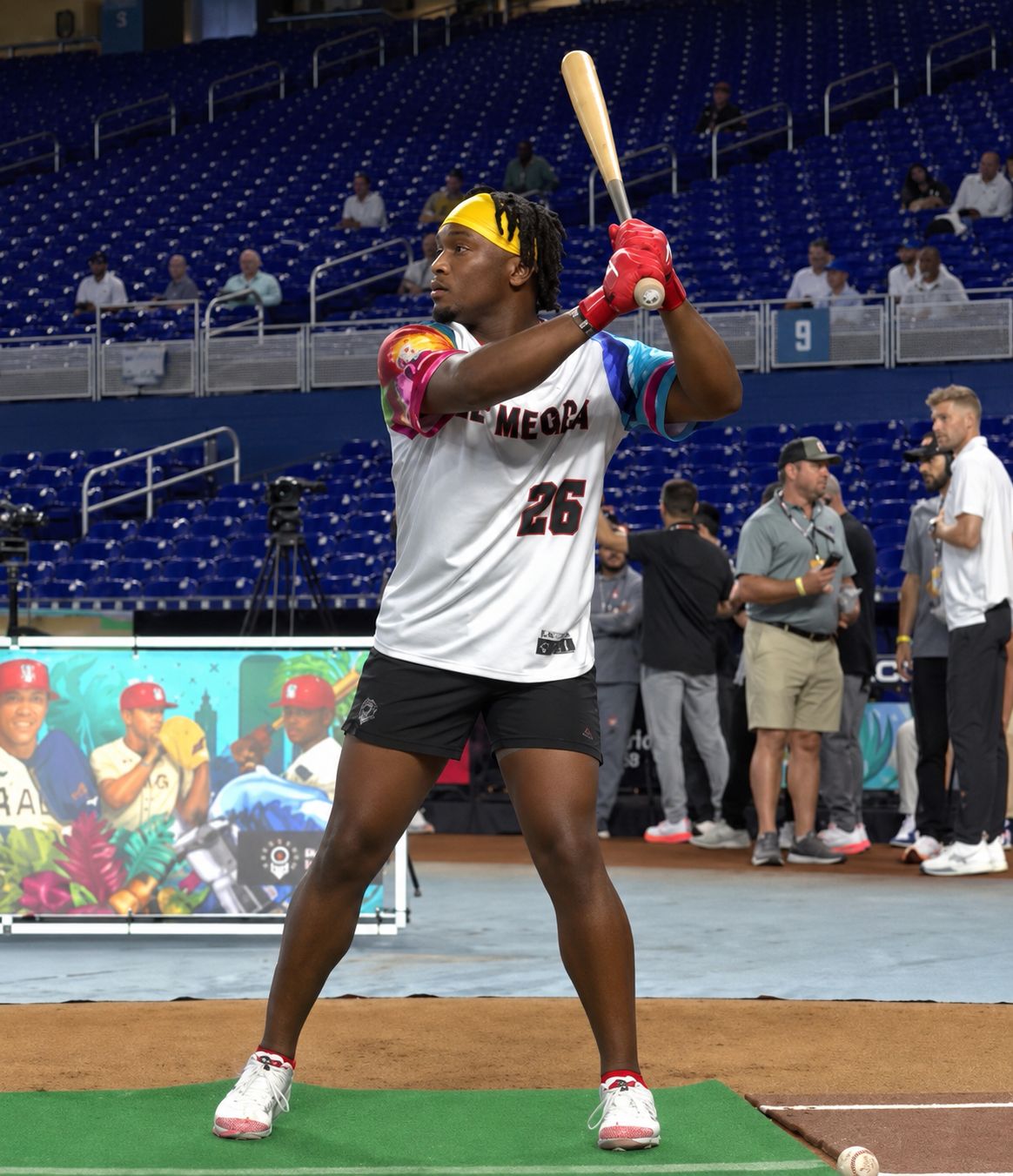
Booth is an 18-year-old center fielder from Oak Grove High School in Hattiesburg, Mississippi. He’s a 6-foot, 205-pound left-handed hitter who was committed to Vanderbilt he turned 18 on July 4, making him one of the youngest players on the board. His father was a standout kick returner at Southern Miss and a 34th-round pick of the Blue Jays back in 1993, so the athletic bloodlines are real.
The Tools
| Tool | Baseball America | MLB Pipeline |
|---|---|---|
| Hit | 55 | 55 |
| Power | 50 | 50 |
| Run | 80 | 70 |
| Field | 55 | 55 |
| Arm | 45 | 50 |
The speed is the headline, and it’s not showcase-circuit hype. Booth has been timed at just over four seconds from home to first and ran a 6.33-second 60-yard dash at East Coast Pro last August, the fastest at the event. Baseball America ranked him the No. 6 prospect in the class and hung an 80 on the run tool, the top of the scale. Whichever grade you prefer, this is one of the fastest players in the draft, and the speed alone makes him a near-lock to stay in center field long-term.
The production matched the tools. Across four varsity seasons at Oak Grove, Booth hit .441 with a .612 on-base percentage and .803 slugging against some of the best public-school competition in Mississippi. As a junior in 2025 he hit .467 with six homers and 27 stolen bases, and he won the home run derby at the Perfect Game All-American Classic that summer.
The Risk
Here’s the honest part. Nearly every scouting report on Booth flags the same concern: the swing. Baseball America notes his mechanics need refinement, even while crediting him with a genuine feel for the strike zone and an opposite-field approach. Other evaluators have gone further, describing him as one of the most volatile prospects in the class claiming he has premium tools attached to an unorthodox swing that may not let him hit as currently built, with an outcome heavily dependent on the Orioles player development staff.
That’s the bet. The Orioles clearly drafted the tools he could grow into. The speed and center field defense give him a real floor giving him a big-league path even if the bat develops slowly. The ceiling only arrives if the Orioles can rework the swing to get him lifting the ball.
The Bradfield Comp (and Why It Undersells Him)
The easy comparison is Enrique Bradfield Jr., elite speed, center field glove, Vanderbilt connection, even the “Jr.” But the profiles diverge in one important place: power. Booth, as a high schooler, is already bigger and stronger than Bradfield was as a college player, hits the ball harder, and has a frame that projects to add more. Bradfield’s tools make him a big leaguer; Booth’s tools plus the power potential are what let you dream on an All-Star. Scouting reports project a possible 20-25 homer, high-steal center fielder if it all clicks.
One more note: this is only the second high schooler taken with the Orioles’ top pick in the Elias era, joining Holliday in 2022, and the third prep first-rounder overall alongside Slater de Brun (No. 37 in 2025 — since traded). Booth is also the second straight Vanderbilt commit the Orioles have pulled away from Nashville. With slot at $7,327,200 for the seventh pick, he’s not making it to campus.
Round 2 (46): Ty Head, OF, NC State
After a long wait, more on that in a second, the Orioles grabbed another center fielder, this one from the college ranks. Head is a draft-eligible sophomore and the highest-drafted NC State player since Patrick Bailey went 13th overall in 2020.
The profile is nearly the inverse of Booth’s: polish over projection. Head’s carrying skill is strike-zone control as he walked 59 times against just 23 strikeouts this season, an outstanding ratio, though the contact hasn’t yet turned into a big average (.293 in 2026). Over two college seasons he racked up 104 hits, 18 homers, and 32 steals in 112 games. The glove is legit: a perfect fielding percentage in center this year and an ABCA Gold Glove, just the third in program history. Draft analysts framed him as a potential 20/20 center fielder with plus contact ability.
Evaluators are all over the map on him though. FanGraphs ranked him as high as No. 16 in the class while MLB Pipeline had him 60th, which is exactly the kind of disagreement that lands a player at pick 46. As an eligible sophomore he carries a little signing leverage, so a modest overslot is possible, but this could easily come in near the $2,181,600 slot.
The Baz Tax
The gap between picks 7 and 46 was self-inflicted. The Orioles dealt their Competitive Balance Round A selection, No. 33 overall, to the Rays in the Shane Baz trade, and Tampa Bay used it on South Carolina prep shortstop Taj Marchand. Names taken in that 33-45 window will be worth tracking for years; Landon Thome, son of the Hall of Famer (and briefly an Oriole), went 34th to the Rockies. If anyone from that stretch pops, it’s part of the real cost of the Baz deal, alongside Caden Bodine, Michael Forret, and Slater de Brun.
Round 3 (82): Dominic Voegele, RHP, Kansas
Stop the presses, the Orioles didn’t take an outfielder. Similar to last year when Orioles took Joseph Dzierwa in the 2nd round and JT Quinn in the 3rd round, they took a pitcher in the 3rd round, nabbing this Kansas University right-hander and Friday Night starter. After a solid Freshman season, he didn’t enjoy as much success as Kansas’ Friday-night guy for much of the last two years, logging a 5.77 ERA, though he did set a school record with 120 strikeouts in 97 innings this spring.
While Voegele sits 93-96 mph fastball and can touch 98, it lacks life, and he too often leaves it over the middle of the plate where it tended to get hit hard by college hitters. He can put hitters away with a low-80s curveball with downer break and a tighter, harder slider, but he’s never shown much feel for a changeup that tends to sit in the upper-80s without much movement.
Voegele is athletic and provides consistent strikes, but reports say his delivery lacks extension and deception. He maintains his velocity deep into games, but has to improve the action and command with his fastball and improve his changeup to remain a starter rather than becoming a breaking ball-heavy reliever at the next level.
We are talking the 3rd round here and Voegele definitely is a high volatility college pitching pick. Maybe the Oriole see him more as a potential impact reliever because I’ll be honest, those stats, including more hits than innings don’t get you too excited.
The raw stuff is something to work with, but the pick will require the Orioles’ pitching development group to rework him a bit for pro ball. Slot here is $1,003,800.
Round 4 (110): Kevin Roberts Jr., OF, Jackson Prep HS (MS)
The Orioles closed Day 1 the way they opened it: with a Mississippi high school outfielder. As a prep pick in round 4, Roberts likely comes with an overslot ask, which makes the pool math interesting, with $13.1M total and Booth commanding the bulk of it, the room for creative maneuvering is tighter than in years when the O’s had comp picks to play with.
Roberts Jr. is an exceptionally gifted high school outfielder from Jackson Preparatory School (MS) who stands at a massive 6-foot-5 and 220 pounds. The right-handed hitter is a “unicorn” four-sport athlete with offers in football, basketball, and track. He boasts one of the absolute highest ceilings in the entire prep class due to a rare blend of 55-grade raw power and 60-grade elite speed, turning heads on the showcase circuit by clocking sub-6.4 second 60-yard dashes and launching balls over 450 feet with exit velocities up to 112 mph.
Compounding his vast projection is his extreme youth, as he will not turn 18 years old until two weeks after the draft. A former Florida commit, he possesses the arm strength (previously hitting 94 mph off the mound) and pure athletic range to easily project as a long-term center fielder or a premium right fielder as his massive frame continues to fill out.
Despite his staggering physical upside, Roberts remains a highly raw prospect whose eventual professional success relies entirely on refining his hit tool. Evaluators note that while he possesses excellent bat speed and leverage, he struggled with his timing during the summer showcase circuit against elite arms, which inflated his ground-ball rates and caused him to chase pitches outside the strike zone. His senior year high school statistics were outstanding, leading his team with a .396 batting average, 10 home runs, and 27 stolen bases, but his 17% strikeout rate at the prep level highlights the swing-and-miss tendencies he will need to clean up. If the Orioles player development staff can steady his approach and help him adjust to quality professional breaking pitches, Roberts profiles as a high-risk, maximum-reward offensive weapon with genuine 30-home run and 30-stolen base All-Star potential.
The Big Picture
Three of four picks were up-the-middle outfielders with speed and defensive value, extending a familiar pattern — that’s now four straight drafts opening with an outfielder (Booth, Ike Irish, Vance Honeycutt, Enrique Bradfield Jr.). But the flavor changed. Instead of the usual safe college bat, the Orioles swung for ceiling with a volatile prep talent, paired him with a high-floor college center fielder, and even sprinkled in a Day 1 arm. It’s the most interesting draft class this front office has assembled in a while — and the most pressure it has put on its own player development to deliver.
Day 2 covers rounds 5-20, starting Sunday at 11:30 a.m. ET. The Orioles pick seventh in every round. We’ll have the full class breakdown when it wraps.