




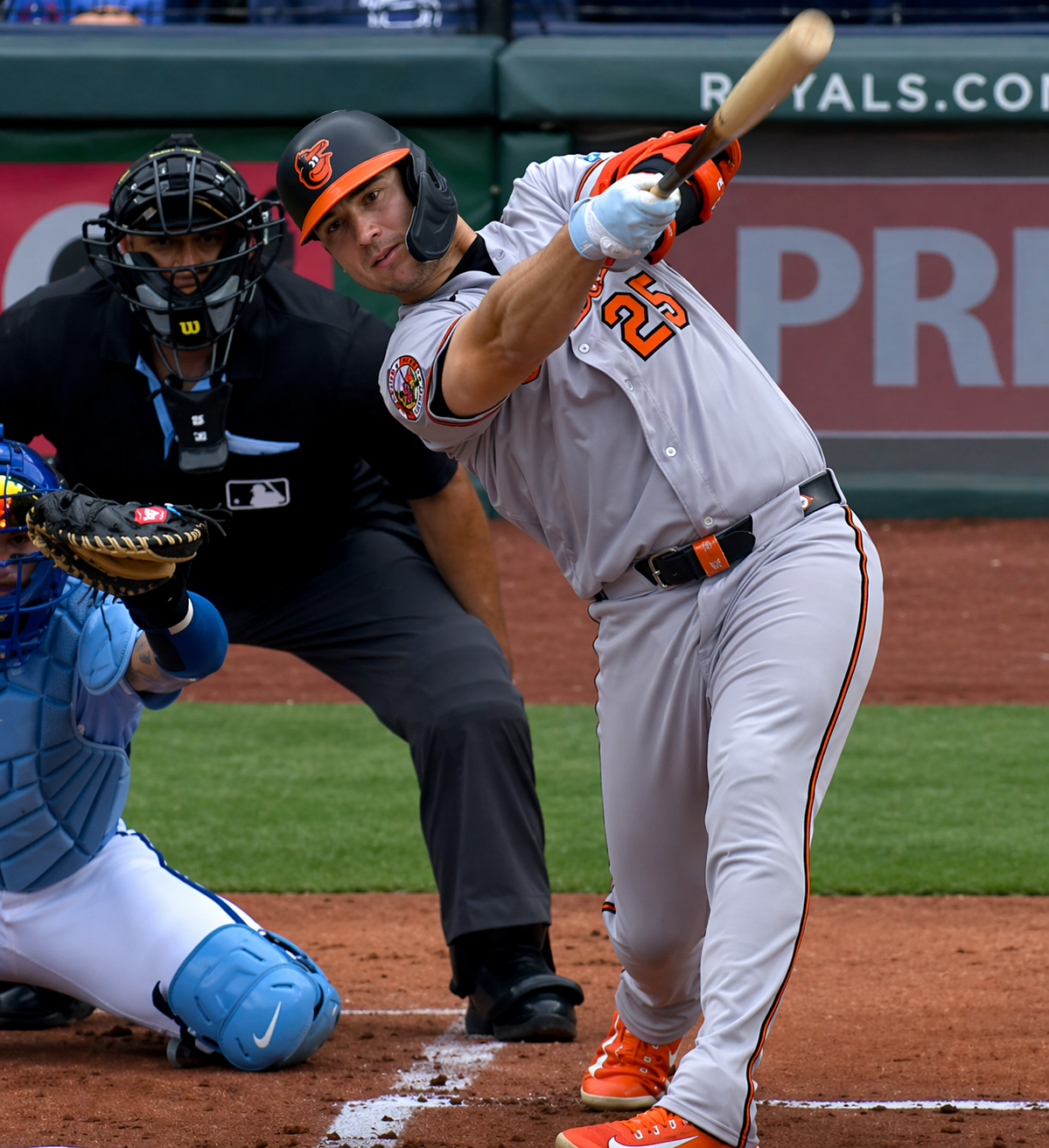
When the Orioles acquired Pete Alonso, they weren’t looking for a contact hitter. They were looking for a middle-of-the-order power bat who could lengthen the lineup and punish mistakes.
So far, that version of Alonso has not shown up.
Through 123 plate appearances, Alonso is hitting just .196/.301/.336 with a .637 OPS and 79 OPS+. That’s a massive drop from last year, when he posted a .272/.347/.524 line with an .871 OPS and 144 OPS+ for the Mets.
At first glance, it would be easy to say Alonso is just slowing down. But after digging into the Statcast data, I don’t think this is simply a case of a hitter losing strength or suddenly being unable to catch up to velocity.
The raw power is still there.
The problem is that the hard contact is not turning into damage contact.
Year-to-year production
| Season | PA | BA | OBP | SLG | OPS | OPS+ | HR | RBI | WAR |
|---|---|---|---|---|---|---|---|---|---|
| 2025 | 709 | .272 | .347 | .524 | .871 | 144 | 38 | 126 | 3.4 |
| 2026 | 123 | .196 | .301 | .336 | .637 | 79 | 3 | 10 | 0.2 |
That is not just a slow start. That is a middle-of-the-order bat producing like a bottom-of-the-lineup hitter.
But the deeper numbers suggest the issue is more specific than just “Alonso is cooked.”
The strength is still there, but the barrels are not
| Stat | 2025 | 2026 |
|---|---|---|
| Avg Exit Velocity | 93.5 MPH | 94.6 MPH |
| HardHit% | 54.4% | 56.0% |
| Barrel% | 18.9% | 8.0% |
| Barrel/PA | 12.6% | 4.9% |
| Sweet Spot% | 38.4% | 28.0% |
| xSLG | .572 | .396 |
| xwOBAcon | .471 | .371 |
This is the key chart.
Alonso is actually hitting the ball harder this year than he did last year. His average exit velocity is up. His hard-hit rate is up. Those are not the numbers of a hitter whose strength has disappeared.
But the barrel rate has cratered.
Last year, Alonso barreled 18.9% of his batted balls. This year, that number is down to 8.0%. His barrel per plate appearance rate has dropped from 12.6% to 4.9%. That is a huge falloff for a hitter whose value is built around impact contact.
For Alonso, hard contact by itself is not enough. He needs hard contact in the air. He needs hard contact to the pull side. He needs the kind of contact that leaves the ballpark.
Right now, he is still hitting the ball hard, but too often it is not coming off the bat in the right window.
He is not getting to his pull-side air damage
| Batted Ball Direction | 2025 | 2026 |
|---|---|---|
| Pull% | 39.3% | 33.3% |
| Straightaway% | 31.6% | 50.7% |
| Oppo% | 29.1% | 16.0% |
| Pull Air% | 18.9% | 12.0% |
| Ground Ball% | 37.8% | 42.7% |
| Line Drive% | 25.5% | 21.3% |
| Fly Ball% | 29.9% | 33.3% |
This is where the timing issue really starts to show up.
Alonso’s pull rate is down from 39.3% to 33.3%, while his straightaway contact has jumped all the way to 50.7%. His pull-air rate has fallen from 18.9% to 12.0%.
That matters a lot.
When Alonso is right, he gets the barrel out front and drives the ball in the air to left field. That’s where his home run damage comes from. Right now, he is hitting more balls straightaway, more balls on the ground, and fewer balls in the air to his pull side.
That usually points to a hitter who is just a tick late or whose contact point is not where it needs to be.
He is not necessarily getting blown away. He is not rolling over everything. He is still making loud contact. But he is not consistently getting to the point of contact that allows him to do real Pete Alonso damage.
Against fastballs, the contact is there, but the damage is not
| Pitch Group | PA | BA | wOBA | EV | Whiff% | K% |
|---|---|---|---|---|---|---|
| Fastballs | 72 | .217 | .324 | 96.8 MPH | 20.5% | 16.7% |
| Offspeed | 13 | .167 | .222 | 93.5 MPH | 32.1% | 23.1% |
| Breaking Balls | 36 | .182 | .273 | 89.4 MPH | 44.1% | 41.7% |
This chart changes the analysis a little bit.
Alonso is not completely overmatched by fastballs. He has a 96.8 MPH average exit velocity against them, with a manageable 20.5% whiff rate and 16.7% strikeout rate. That is not a hitter who simply can’t catch up to velocity anymore.
But for Alonso, a .324 wOBA against fastballs is not enough.
Fastballs are the pitches he has to punish. He is still hitting them hard, but the contact is not producing enough damage. That lines up with the overall batted-ball profile. He is making hard contact, but not enough of it is being lifted and pulled.
So the fastball issue is not “he can’t hit them.”
It’s more this:
He can still hit fastballs hard, but he is not getting them in the air with authority often enough.
That is a much different problem.
Breaking balls are becoming the finishing pitch
The bigger swing-and-miss issue is against spin.
Alonso has a 44.1% whiff rate and 41.7% strikeout rate against breaking balls this year. That is the number that should get your attention.
Pitchers don’t need to completely beat him with velocity. They can show him enough fastballs to keep him honest, then finish him with breaking stuff. The breaking-ball results are not just bad. They are giving pitchers a clear roadmap.
That’s why this slump looks like a combination problem.
He is not doing enough damage when he gets fastballs, and he is giving pitchers too many empty swings when they go to breaking balls.
That’s a bad combination for any hitter, but especially for a slugger who needs to punish mistakes.
The bat speed drop is worth watching
| Bat Tracking Stat | 2025 | 2026 |
|---|---|---|
| Avg Bat Speed | 75.3 MPH | 73.9 MPH |
| Fast Swing Rate | 53.4% | 37.8% |
| Swing Length | 7.1 ft | 7.2 ft |
| Squared-Up Contact% | 33.6% | 36.2% |
| Blast Contact% | 22.7% | 22.7% |
This is where there is at least some concern.
Alonso’s average bat speed is down from 75.3 MPH to 73.9 MPH, and his fast swing rate has dropped from 53.4% to 37.8%. That does not mean his bat is slow. It is still above league average. But for Alonso, that kind of drop matters.
His swing length is basically unchanged, so this does not look like a hitter who has shortened up to make more contact. It looks like the same general swing with a little less explosiveness.
That half-beat can matter.
For a hitter like Alonso, being just a fraction late can turn a pulled homer into a hard fly ball to center. It can turn a barrel into solid contact. It can turn an elevated fastball into a hard grounder or a miss underneath.
The encouraging part is that his squared-up contact rate is actually up. He is not completely lost. He is still finding the ball. He is just not finding it in the right damage window often enough.
My read
I don’t think Alonso is done.
I also don’t think this is just bad luck.
His actual .294 wOBA is lower than his .319 xwOBA, so yes, he has probably deserved a little better than the surface numbers. But last year, his xwOBA was .386. Even the expected numbers show a hitter who has taken a real step back from his 2025 form.
The issue is not strength. The exit velocity and hard-hit rate tell us that.
The issue is timing, launch, and pitch coverage.
Right now, Alonso is still strong enough to hit the ball hard. He is still capable of doing damage. But he is not getting the barrel to the right spot often enough. He is not pulling enough balls in the air. He is not punishing fastballs like Pete Alonso needs to punish fastballs. And when pitchers get him into finish counts, breaking balls are eating him up.
That is how you end up with a hitter who has a 56.0% hard-hit rate but only an 8.0% barrel rate.
The Orioles don’t need Alonso to reinvent himself. They need him to get back to being the hitter he has always been: get the ball out front, lift it to the pull side, and make pitchers pay when they miss.
Until that happens, this version of Alonso looks more like a dangerous mistake hitter who isn’t getting to enough mistakes, rather than the middle-of-the-order force the Orioles thought they were adding.