





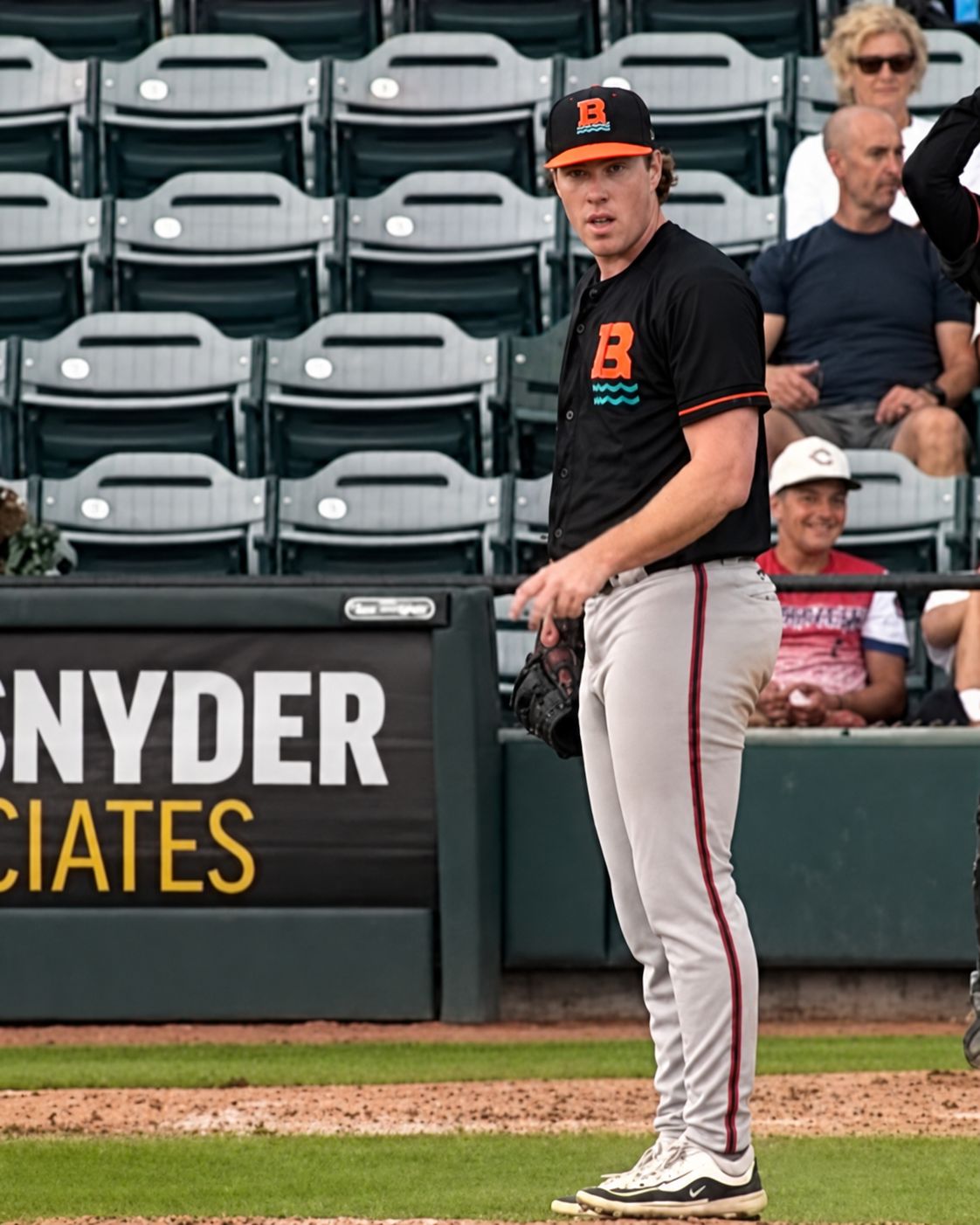
After watching Caden Hunter pitch in his Double-A debut yesterday, it’s not hard to picture him as one of the team’s best pitching prospects. The best part of his stellar debut was that it was not just a raw-stuff outing where he overwhelmed hitters with velocity. He showed a legitimate starter’s mix: fastball, changeup, slider, and curveball, with the changeup looking like a real weapon and the fastball still holding enough quality deep into the outing. He combined them all by keeping his composure even during a blip in the 5th inning when he briefly lost his command and velocity a bit, only to regain them and finish strong.
Overall takeaway
This was about as dominant as it gets for a first Double-A start. Hunter carried a no-hit bid into the 7th, generated whiffs with multiple pitches, allowed very little hard contact, and showed the ability to reset after his only real trouble spot.
The key scouting development is the changeup. Coming into Double-A, the fastball/slider and A-ball swing-and-miss numbers were already loud. The question was whether the changeup would keep playing against better hitters. In this start, it absolutely did. It had good drop, arm-side life, and enough deception off the fastball to produce repeated whiffs, especially down and away.
That changes the profile. This looked like a real starting pitcher, not just a power arm with relief risk.
Fastball
Hunter’s fastball opened extremely strong. Early in the outing he was mostly 95-97 MPH, touching 98, and he used it effectively in different parts of the zone.
He got:
- 96 up for a whiff in the 1st.
- 95 for a swinging strikeout in the 2nd.
- 97 on the outside corner for a looking strikeout in the 3rd.
- 97 for a swinging strikeout later in the 3rd.
- 97 up for a whiff strikeout in the 4th.
- 95 low and away for a looking strikeout in the 5th.
- 94-95 life again in the 6th and 7th after the brief 5th-inning wobble.
That last part is important. The 5th inning could have looked like a fatigue flag if the fastball had stayed 92-93 afterward, but it did not. He recovered. He was back in the 94-95 range later, which suggests the earlier dip was more about timing, mechanics, or losing feel for the zone than him running out of gas.
The fastball continues to look like a carrying pitch. It missed bats, got called strikes, jammed hitters inside, and produced defensive swings. Double-A hitters did not look comfortable against it.
Changeup
The changeup may have been the best pitch in the outing.
It sat mostly 86-88 MPH, with a few later in the 84-85 range, and it had the action you want: drop, arm-side run, and late dive below barrels. He threw it with confidence to right-handed hitters and repeatedly got them to chase or swing over it.
Notable changeups:
- 88 MPH changeup bounced to third for a 5-3 in the 1st.
- 87 MPH changeup for a whiff in the 2nd.
- 87 MPH changeup low and away for a swinging strikeout in the 3rd.
- 86 MPH changeup for a whiff in the 4th.
- 88 MPH changeup dribbled for a 2-1 putout in the 4th.
- Back-to-back changeup whiffs at 85-86 in the 5th.
- 88 MPH changeup for a shallow F9 in the 5th.
- 86 MPH changeup for a whiff in the 6th.
- 88 MPH changeup low and away in the dirt for another whiff in the 6th.
- 86 MPH changeup diving into the dirt for a whiff in the 7th.
- 88 MPH changeup low and away foul-tipped for a strikeout in the 7th.
That is a lot of whiff and weak-contact evidence. The changeup was not just a third pitch. It was a legitimate weapon. It gave him a way to neutralize right-handed hitters without relying only on fastball/slider, and it helped him keep hitters off the fastball even when he was deep into the outing.
For Hunter’s starter projection, this is the biggest positive from the start.
Slider
The slider was a strong supporting pitch. It sat mostly 85-88 MPH and gave him a harder breaking-ball look between the fastball and changeup.
He used it for early-count strikes, chase, and at least one big put-away pitch. The most important slider came in the 5th inning after he had walked two batters and the runners moved up to second and third. In that spot, he threw a nasty down-and-in slider for a swinging strikeout.
That was a real mound-composure moment. He had lost the zone, created his own trouble, then got out of it with fastball execution and a quality slider. That matters in a first Double-A start.
The slider still feels like the pitch with some command volatility. He can miss with it, and it was not as consistent as the changeup in this start. But the shape and bat-missing ability are there.
Curveball
The curveball was a usable fourth pitch, mostly 81-84 MPH. He showed it enough to keep hitters from eliminating it, and it produced some swing-and-miss.
The best examples:
- 83 MPH curveball used in the 2nd after fastball/slider/change.
- 84 MPH curveball lined to center in the 2nd, but not crushed.
- 82 MPH curveball for a whiff in the 6th.
- Curveball low and outside for a whiff in the 7th.
- 82 MPH curveball for a strike in the 7th.
It is probably still behind the fastball, changeup, and slider, but it gives him a different speed band and a more vertical breaking-ball shape. For a starter, that fourth look is valuable.
Command and pitchability
This was mostly a very good command outing with one clear lapse.
Through four innings, Hunter looked in complete control. He threw strikes, expanded intelligently, and had very few noncompetitive pitches. He was not just scattering velocity around the zone. He was sequencing.
The 5th inning was the rough spot:
- Four-pitch walk.
- Another walk after missing with fastballs.
- Fastball dipped into 92-94.
- A pitch got away from the catcher and moved runners to second and third.
But the response was excellent. He came back with a fastball strikeout looking, got a shallow flyout on the changeup, then finished the inning with a nasty slider for a strikeout. That inning actually gives you more confidence in him because he showed he could get out of trouble after briefly losing his delivery.
And again, the key update is that he was back to 94-95 in the 6th and 7th. So the 5th was not a true fade. It was a temporary loss of feel.
Contact quality
There was very little loud contact.
The most notable hard contact was the 103 MPH lineout to shortstop in the 4th. There was also a deep fly to right-center in the 1st, but for the most part, hitters were either missing, fouling pitches off, or making soft/controlled contact.
The contact profile included:
- 1-3 comebacker
- 5-3 grounder
- P-3 foul popup
- Multiple F8s
- Dribbler to the catcher
- Shallow F9
- Pop to second
The first hit did not come until the 7th, on a 94 MPH fastball lined into left field. That tells you how little damage hitters were doing for most of the outing.
What this start says about him
This was a major positive because Hunter checked a lot of starter boxes:
| Trait | Evaluation |
|---|---|
| Fastball quality | Played immediately in Double-A; 95-98 early, 94-95 late |
| Changeup | Best developmental sign; real drop/fade and repeated whiffs |
| Breaking balls | Slider flashed put-away quality; curveball gave him a fourth look |
| Strike throwing | Mostly around the zone with few uncompetitive pitches |
| Adversity response | Lost command in the 5th, then escaped and rebounded |
| Stamina | Better than the 5th-inning dip first suggested because velo returned late |
| Contact management | Very little hard contact; first hit came in the 7th |
Updated scouting grades
| Pitch/Skill | Present | Future | Notes |
|---|---|---|---|
| Fastball | 60 | 60/65 | 92-98, mostly 95-97 early, 94-95 late, bat-missing shape |
| Changeup | 50/55 | 60 | Best pitch in this look; drop, fade, whiffs, weak contact |
| Slider | 45/50 | 55 | 85-88, put-away quality when finished |
| Curveball | 45/50 | 50 | Usable fourth pitch with some whiff flashes |
| Control | 50 | 55 | One shaky inning, otherwise filled the zone well |
| Command | 45 | 50 | More refined than walk history suggests in this start |
Final evaluation
Hunter’s Double-A debut was a legitimate breakout-type start. He showed the same fastball traits that made him dominant in A-ball, but the bigger story was the changeup. It looked like a real above-average pitch, not just a developmental third offering. When a pitcher can pair 95-98 early velocity, 94-95 late velocity, a riding fastball, a bat-missing changeup, a usable slider, and a curveball for a fourth look, that is a starter’s arsenal.
The only concern was the 5th-inning command lapse, but the revised velocity note makes that less worrisome. Since he was back to 94-95 in the 6th and 7th, this does not look like a pitcher who ran out of gas. It looks like a young arm who briefly lost feel, corrected himself, and kept dominating.
He’s definitely one of the best pitching prospects in the system and may challenge Joseph Dzierwa for that honor by year’s end if he can continue to command this way. Between him, Dzierwa and Luis De Leon, the Orioles have a nice set of left-handed starting options coming available to them soon.