






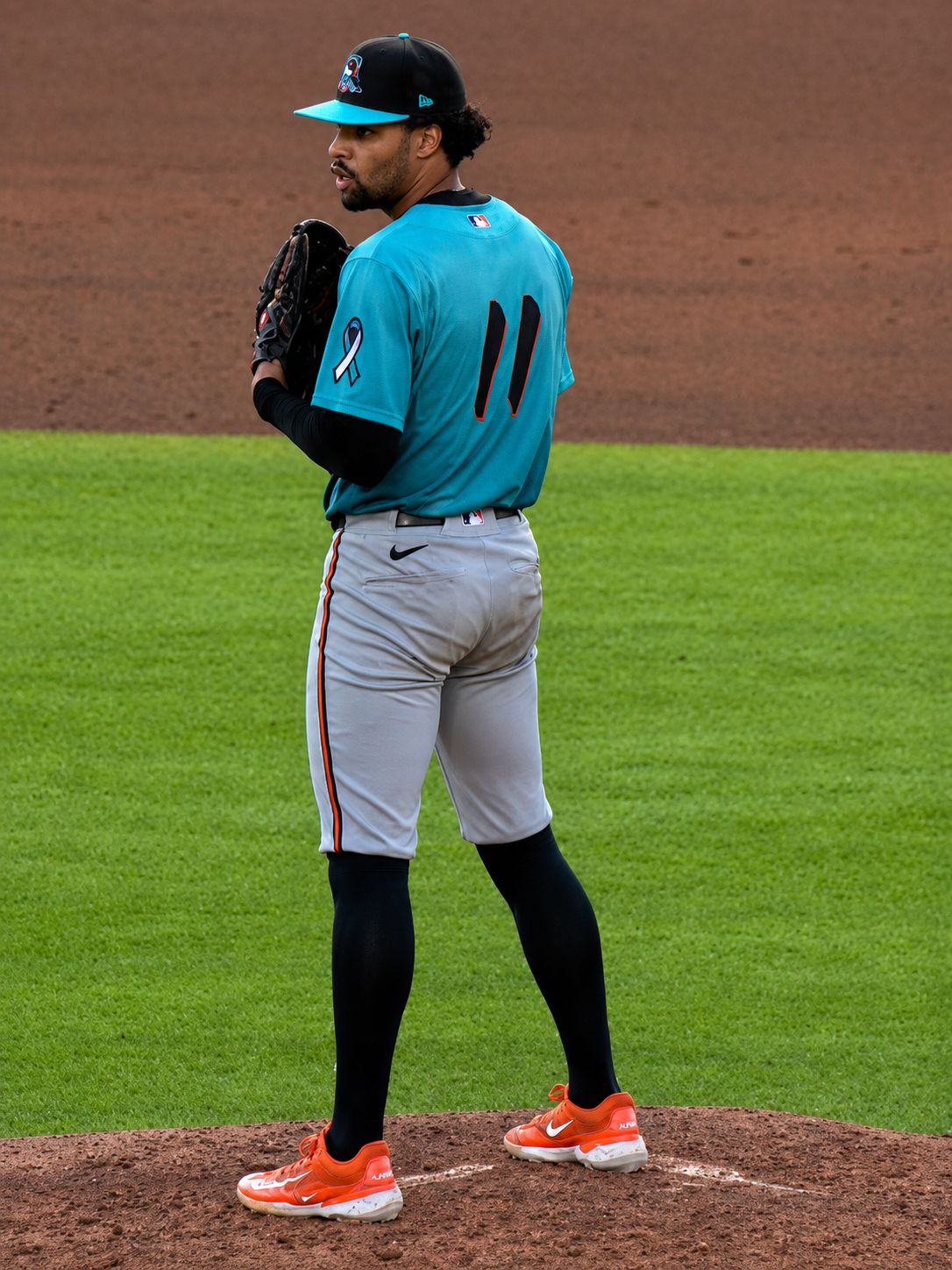
Juaron Watts-Brown’s Double-A season still looks rough on the surface. Even after a strong outing yesterday, he owns a 6.22 ERA with Chesapeake, and the overall profile has been uneven: too many walks, too much damage in the air, and not enough consistent fastball command to comfortably project him as a traditional starter.
But the surface ERA does not tell the whole story.
Over his last four starts, Watts-Brown has shown the kind of bat-missing stuff that makes him interesting. In that stretch, he has thrown 21.1 innings with a 2.95 ERA, 1.13 WHIP, 27 strikeouts, and only five walks. That includes a 31.0% strikeout rate, 5.7% walk rate, and a very strong 16.0% swinging-strike rate, which are the kind of number that points to real stuff, not just favorable sequencing or weak contact luck.
The question is whether it’s time to start developing him for his most likely major league role, a multi-inning reliever.
Watts-Brown’s latest start was a good example of both his appeal and his limitations. The slider was the clear separator. It produced ugly swings from both left-handed and right-handed hitters, showing sharp diving action with some horizontal finish. Against righties, he could bury it low and away. Against lefties, he used it down and in as a back-foot weapon. It was not just a chase pitch either; he showed the ability to land it in the zone when he needed a strike, then expand later in the count.
That gives him a legitimate major league-caliber weapon.
The fastball was mostly 94-96 mph, and while it can look a little straight, he was around the plate with it and used it well enough to set up the slider. His best sequences came when he established the fastball early, changed eye levels, and then either finished with the slider below the barrel or elevated the fastball above the hands.
In one fourth-inning sequence, he started a right-handed hitter with a fastball on the inside corner, landed a slider for a strike on the outside edge, then worked the fastball up and in before finishing him with a 96 mph fastball for a swinging strikeout. That is the version of Watts-Brown that makes you pay attention.
The problem is that the rest of the starter package remains incomplete.
The curveball flashes as a useful third look to steal a strike, but it is inconsistent. At times it can get loopy, and it does not look like a pitch he can consistently lean on as a major weapon. The changeup is a bigger issue. In the latest look, he showed it, but he did not appear to have much feel for it. Several were high or poorly located, and it did not look like a dependable weapon against left-handed hitters.
For a starter, that matters. A right-handed pitcher can survive without a plus changeup if he has premium fastball traits, plus command, or multiple dominant breaking balls. Watts-Brown has good stuff, but not quite that level of margin. His fastball is usable but not overpowering. His command is slightly below average. His slider is good enough to miss bats, but asking him to turn over lineups multiple times without a reliable changeup puts pressure on every fastball and every breaking ball he throws.
That is why the Orioles should consider moving him to relief.
At 24 years old, Watts-Brown is reaching the point where role development matters. It is not just about whether a pitcher can throw four pitches or give a team five innings in the minors. It is about preparing him for the role he is most likely to fill in the major leagues.
A starter’s routine is different from a reliever’s routine. Starters get several days to prepare. They go through a longer pregame progression. They know when they are pitching and can build their day around that start. Relievers have to get hot quickly, recover faster, handle irregular usage, and sometimes enter games with traffic already on base.
Those things have to be learned.
If the Orioles believe Watts-Brown’s most likely major league role is as a bullpen arm, then they should start developing him that way. Let him adjust to warming up quickly. Let him pitch more frequently. Let him experience shorter rest. Let him learn how his stuff plays when he can attack in one- or two-inning bursts instead of pacing himself for five or six.
That does not mean turning him into a one-inning reliever immediately. In fact, Watts-Brown may be more interesting as a multi-inning or bulk reliever. His fastball-slider combination gives him a strong foundation, and the occasional curveball and show-me changeup give him enough variety to face both lefties and righties. He does not need to be a pure two-pitch arm.
In shorter outings, there is also a chance the fastball plays up. If he is sitting 93-96 mph as a starter, perhaps he can sit more consistently 95-96 in relief, with a little extra when he reaches back. Pair that with a slider that already misses bats, and suddenly the profile looks much more appealing.
But the Orioles also need to be realistic. His 6.22 Double-A ERA, lack of a dependable changeup, below-average command, and fly-ball damage concerns make it harder to project him as a stable major league starter. The better path may be to stop trying to stretch the starter projection and instead optimize what he already does well.
Fastball. Slider. Occasional curveball. Rare changeup. Attack hitters. Miss bats. Cover multiple innings.
That could be a useful bullpen piece as soon as next season for a team with a need for bullpen help.
Watts-Brown still has starter traits, but his most likely major league future may be in relief. The Orioles should strongly consider making that transition now, not because he has failed as a starter, but because his best weapons may play faster, sharper, and more effectively in a bullpen role.