
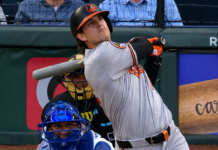





Tyler O’Neill was supposed to be a classic upside play.
The Orioles were not buying a perfect hitter. They were buying impact. They were buying bat speed, strength, damage, and the idea that even with swing-and-miss, O’Neill could change games when he squared the baseball up.
But the Statcast data is starting to paint a much more concerning picture.
This doesn’t look like a normal slump. It looks like a hitter whose carrying tool may be disappearing.
The Bat Speed Has Fallen Off a Cliff
The most alarming part of O’Neill’s profile is not the batting average. It’s not even the strikeouts. It’s the bat speed.
| Season | Avg Bat Speed | Fast Swing Rate | Swing Length | Blast Contact % | Squared-Up Contact % |
|---|---|---|---|---|---|
| 2023 | 72.4 mph | 24.6% | 7.0 ft | 16.6% | 33.2% |
| 2024 | 75.2 mph | 51.8% | 7.6 ft | 18.1% | 28.3% |
| 2025 | 74.0 mph | 34.6% | 7.7 ft | 16.2% | 31.9% |
| 2026 | 71.6 mph | 12.1% | 7.3 ft | 10.9% | 31.9% |
| MLB Avg | 71.7 mph | 23.9% | 7.3 ft | 14.1% | 32.9% |
In 2024, O’Neill was still swinging the bat with elite violence. His 75.2 mph average bat speed and 51.8% fast swing rate were the foundation of the entire profile.
That player could strike out. That player could run hot and cold. But that player could still punish mistakes.
The 2026 version is a different hitter.
His average bat speed is now basically league average, and his fast swing rate has cratered to 12.1%, well below the MLB average of 23.9%. His blast contact percentage has also dropped from the 16–18% range to just 10.9%.
For a player whose offensive value is built around power, that is a major warning sign.
The Barrel Rate Has Collapsed
The bat-tracking data would be concerning by itself. But the batted-ball data backs it up.
| Season | Barrel % | Barrel/PA | Exit Velocity | HardHit % | xBA | xSLG | wOBA | xwOBA | K% | BB% |
|---|---|---|---|---|---|---|---|---|---|---|
| 2024 | 17.3% | 9.3 | 90.9 | 48.8% | .211 | .489 | .360 | .340 | 33.6% | 11.2% |
| 2025 | 16.5% | 10.5 | 88.8 | 39.1% | .243 | .523 | .297 | .360 | 24.4% | 10.5% |
| 2026 | 4.5% | 2.9 | 87.7 | 36.4% | .180 | .310 | .240 | .275 | 23.8% | 11.4% |
| MLB Avg | 7.6% | 4.9 | 88.6 | 37.0% | .243 | .408 | .315 | .316 | 22.2% | 8.4% |
This is the problem.
O’Neill’s strikeout rate has actually improved from where it was in 2024. His walk rate is still fine. He is not completely lost from a zone-control standpoint.
But the impact has disappeared.
His barrel rate has gone from 17.3% in 2024 and 16.5% in 2025 to just 4.5% in 2026. His expected slugging has dropped from .523 last year to .310 this year. His xwOBA has fallen to .275, well below league average.
That’s not just bad luck. That’s a different quality of contact.
The Scariest Part: He Is Making More Contact, But Doing Less Damage
This is where the profile gets really concerning.
Usually with a hitter like O’Neill, you accept the swing-and-miss because the damage is worth it. You live with the strikeouts if the hitter is still hitting the ball hard, barreling mistakes, and slugging the baseball.
But in 2026, O’Neill is not striking out at an outrageous rate. He is just not doing damage when he makes contact.
That is a much worse sign.
A power hitter with swing-and-miss can survive if the power is still elite.
A power hitter with average bat speed, below-average barrel production, and declining defensive value becomes a much tougher roster fit.
Pitchers Can Attack Him With Secondary Stuff
The pitch-type data shows another major problem. O’Neill is not just struggling overall. He is getting handled badly by breaking balls and offspeed pitches.
| Season | Pitch Type | BA | SLG | xSLG | wOBA | xwOBA | EV | LA | Whiff % |
|---|---|---|---|---|---|---|---|---|---|
| 2026 | Fastball | .176 | .314 | .411 | .287 | .332 | 90.3 | 28° | 17.5% |
| 2026 | Breaking | .136 | .136 | .180 | .212 | .228 | 78.9 | 7° | 50.0% |
| 2026 | Offspeed | .111 | .111 | .183 | .131 | .161 | 86.6 | 25° | 47.2% |
| 2025 | Fastball | .225 | .461 | .624 | .325 | .403 | 90.7 | 25° | 22.5% |
| 2025 | Breaking | .154 | .288 | .442 | .255 | .332 | 86.4 | 22° | 38.4% |
| 2025 | Offspeed | .185 | .333 | .294 | .273 | .261 | 83.5 | 8° | 52.4% |
| 2024 | Fastball | .257 | .539 | .533 | .376 | .359 | 93.4 | 26° | 30.0% |
| 2024 | Breaking | .220 | .504 | .452 | .355 | .326 | 88.4 | 17° | 41.1% |
| 2024 | Offspeed | .208 | .396 | .384 | .279 | .277 | 84.3 | 2° | 35.3% |
There is still a little bit of hope against fastballs. His actual numbers are poor, but the expected numbers are better. A .332 xwOBA against fastballs is playable.
But against breaking balls and offspeed pitches, the numbers are ugly.
Against breaking balls in 2026, he has a .136 batting average, .136 slugging percentage, .228 xwOBA, and 50% whiff rate.
Against offspeed pitches, it is even worse: .111 average, .111 slugging, .161 xwOBA, and 47.2% whiff rate.
That is a clear attack plan for opposing pitchers.
You can challenge him with fastballs when needed, but the path to getting him out is obvious: spin him, change speeds, and make him prove he can still impact something other than a mistake heater.
This Looks Like a Physical Decline, Not Just a Timing Slump
The stance and swing-path data suggest O’Neill has made adjustments. He is more open. He is deeper in the box. His swing length has shortened back toward league average.
| Season | Stance Angle | Depth in Box | Distance Between Feet | Intercept Point vs. Front of Plate | Attack Angle | Ideal Attack Angle % |
|---|---|---|---|---|---|---|
| 2024 | 4° open | 25.0 in | 32.5 in | 6.3 in | 18° | 53.5% |
| 2025 | 10° open | 25.2 in | 29.5 in | 8.5 in | 19° | 47.1% |
| 2026 | 17° open | 29.3 in | 26.7 in | 3.9 in | 15° | 55.2% |
| MLB Avg | 11° open | 27.9 in | 29.9 in | 2.9 in | 10° | 51.0% |
The swing path itself is not a disaster. His ideal attack angle percentage is actually solid. He is not simply chopping balls into the ground or swinging with a completely broken path.
That almost makes this more concerning.
The path is fine enough. The contact rate is not terrible. The walks are still there. The strikeout rate is not out of control.
But the violence is gone.
That points more toward physical decline, bat-speed erosion, or an inability to consistently access his old power in game action.
The Orioles Needed the Old Tyler O’Neill
The Orioles did not need O’Neill to be a high-average hitter. They did not need him to be a complete offensive player. They needed the version who could punish left-handed pitching, run into mistakes, and provide real thump in the middle or lower half of the order.
But if the current version is a league-average bat-speed hitter with below-average barrels and limited defensive value, that player is not very useful.
This is where the age factor matters. O’Neill is in his age-30/31 phase, and the skill that appears to be fading is the exact skill that made him valuable in the first place.
For some hitters, losing a step of bat speed is survivable because they have elite bat-to-ball skills, plate coverage, or defensive value.
O’Neill’s game has never been built that way.
His game was built on impact.
Bottom Line
There is still some chance O’Neill rebounds. The fastball expected numbers are not completely dead, and his walk/strikeout profile is not as ugly as the surface production.
But the overall picture is not encouraging.
The data says this is not simply a hitter getting unlucky. It says the bat speed is down, the fast swings are gone, the barrels have disappeared, the expected slugging has cratered, and pitchers can beat him with secondary stuff.
That is not a small slump.
That is the profile of a power hitter who may no longer have enough power to justify the rest of the package.
And if that is true, then the uncomfortable question has to be asked:
Are we watching the end of Tyler O’Neill as a productive major league hitter?